Building AI for Reliable Execution: Lessons From Industrial Robotics
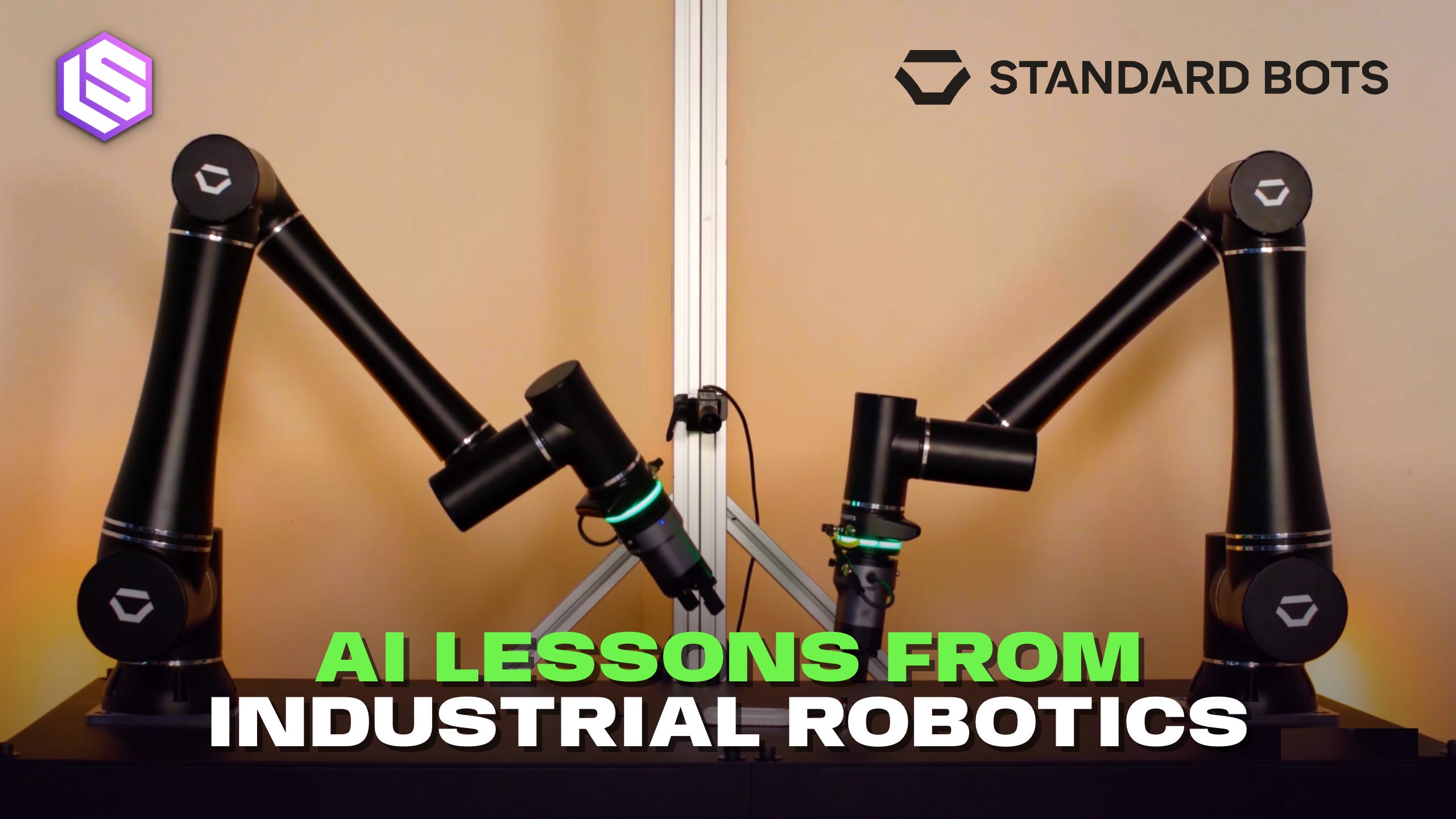
Standard Bots, which describes itself as America's largest AI-native industrial robot manufacturer, recently closed a $200 million Series C at a $1 billion valuation. The round was led by General Catalyst and RoboStrategy, a fund focused on robotics. Its robot arms are aimed at machine tending, welding and assembly, and its customer list includes NASA, Amazon and Lockheed Martin. Co-founder and CEO Evan Beard and Head of AI Leif Jentoft described the company's AI stack and how its models are trained, adapted and run.
The architecture starts with a shared base model that customers adapt through demonstrations and fine-tuning, rather than training a bespoke model per deployment. Jentoft said the company runs a range of models, including a zero-shot perception system used for machine tending. Beard put the largest model in the low billions of parameters, which is modest next to frontier foundation models. The company's stated position is that data quality outweighs raw volume: Jentoft said the focus is on getting the most out of targeted data instead of chasing the biggest possible dataset. He added that in-situ interventions can fix an edge case with a few dozen examples, and that the company's market access gives it unusual access to high-value data.
That argument is familiar from elsewhere in applied AI, where teams increasingly find that a narrowly scoped task with well-chosen examples beats a larger general model. This is my own reading, but the trade-off is visible: a small, targeted model is cheap to run and easy to correct, yet carries less headroom for tasks the team never anticipated.
Where the learning sits in a workflow is deliberately narrow. In the machine-tending product for high-mix manufacturing, a user tells the robot which parts to look for. The model does perception, locating and identifying parts, while conventional programming handles motion and the cell logic around the robot. The perception backbone for that task was trained on more than a billion images, which Jentoft said lets it cope with varying lighting and material types and tell an object apart from its background. Beard said the company favors short-horizon tasks that satisfy production requirements for cycle time and reliability, and falls back on ordinary programming wherever learned behavior adds nothing.
Standard Bots builds the arm, the end effector, the control system and the AI itself. Jentoft argued that owning the full stack allows co-optimizing models and control policies, and asserted that no model today is truly hardware-agnostic, so tight coupling of low-level control and higher-level functions speeds both performance and iteration. That claim is contestable; companies such as Skild are explicitly pursuing cross-hardware generalization of robotic intelligence. In practice, a vertically integrated vendor can tune latency and safety margins end to end, but customers inherit a single supplier for hardware and software alike.
Training runs in the cloud, while inference runs locally on the robot. Sensors including wrist cameras feed raw pixels and signals over internal gigabit Ethernet, routed inside the arm so no cables tangle, and edge GPUs turn that into action chunks that stream to low-level control. Beard framed on-premise inference as a requirement rather than a preference: factories and warehouses frequently lack reliable internet, mobile robots even more so, and uptime drives customer acceptance, so the control loop stays local. This is a sensible constraint for anyone building physical systems: the conventional wisdom that inference belongs in a managed cloud does not survive contact with a factory floor where a dropped connection stalls a production line.
Simulation covers some training and validation, but Beard named tasks that current simulators struggle to reproduce, including work with liquids, suction and cutting flexible material. Real-world demonstrations fill the gap, and the company also offers a handheld touch device for teaching a robot a motion.
Failure handling feeds back into the models selectively. Jentoft said the company captures failure signals and human corrections from deployments, and that how the data is used depends on the customer. Many defense customers run in air-gapped environments where nothing returns. For other customers, fleet learning benefits their own applications enough that contributing data in exchange for performance reportedly draws little pushback.
Beyond selling arms, Standard Bots exposes its platform to outside developers through StandardOS, a set of APIs and SDKs. Beard said developers can use whichever parts of the stack they need, including bringing their own models; he cited NVIDIA Cosmos, the open family of world models for physical AI whose version 3 shipped in late May, as one example. Today that integration means writing custom code, and the company plans to make collecting data, training models and deploying them onto its robots easier.
Why it matters: for developers and product teams, the useful pattern here is scoping a learned model tightly, letting conventional code handle deterministic motion and logic, and closing the loop with a few dozen real corrections instead of a huge dataset. Teams building software agents can borrow the same shape, and teams building physical products should treat on-premise inference and intermittent connectivity as design constraints rather than edge cases. The implication, which is my inference from these stated positions, is that reliability in industrial AI will be won through integration and field data rather than model scale alone.
Based on reporting from the original publisher. Visit the source for full context and later updates.
Publisher excerpt
Inside Standard Bots’ AI stack, pretrained models learn factory tasks from demonstrations and improve through corrections from real deployments.