[AINews] Modal’s $1B ARR, $16B Series D makes it NYC’s newest AI Infra Decacorn, 3x usage and 3x valuation in 5 months, 15x in 1 yr
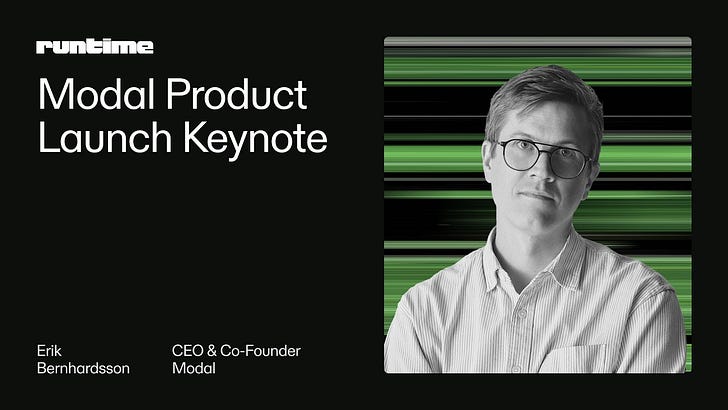
Modal announced it has crossed $1 billion in annualized run rate and raised a $750 million Series D at a $15.75 billion valuation, led by Accel. The company said usage has tripled since its Series C and has grown more than 15x year over year. The funding round and revenue milestone were disclosed together on October 14, 2026, alongside commentary from Modal CTO Akshat Bubna.
Bubna noted that the last public catch-up with the company came in July, on the final day of AIE NYC, when he described the kinds of infrastructure agents need: millions of concurrent sandboxes, secure and elastic RDMA clusters for distributed training, training state-of-the-art speculators for inference, and building a whole new sandbox runtime. In a smaller anecdote, he recalled a Modal user processing large-scale weather data, and that the team was anxious about asking them to pay roughly $500 to keep running those jobs, a sum they thought was a lot at the time. That figure, he noted, now sits well below the company's current scale.
Sandboxes are the product line carrying a large share of that scale. In a post about the fundraise, Erik noted that Modal launched Sandboxes in 2023 after noticing people were using LLMs to generate code. That product has since grown into a $300 million run-rate business on its own. It serves background agents, reinforcement learning, and vibecoding platforms, among other uses. Modal says it has spun up close to 3 billion sandboxes, and that they scale to a million concurrent.
This is a remarkable step up for a company that, five months ago, was still being tracked in the infra unicorn category. The headline framing puts Modal at decacorn status as of this round, with usage and valuation each growing roughly threefold in five months and about fifteenfold over a year. The revenue number, the round size, the valuation, and the growth multiples all come from the company's own announcement, so they are self-reported figures rather than audited financials. That distinction matters when comparing infrastructure companies: run rate is an annualized snapshot, not recognized revenue, and it can swing with usage-based billing.
The backdrop here is the shift in what developers are actually running on cloud infrastructure. When the company noticed code-generating LLMs in 2023, it bet that code execution itself would become a first-class cloud primitive. That bet looks reasonable now. Agents that write and execute code need somewhere to run it, at low latency, with isolation, and at very high concurrency. A sandbox is simply an isolated execution environment: code runs there without being able to touch the host machine or other tenants. If you are building a background agent, an RL loop, or a code-generation product, you are likely starting a large number of short-lived sandboxes. Concurrency and cold-start time become the defining metrics rather than raw CPU or memory.
RDMA clusters for distributed training are the other half of the story Bubna described. RDMA, or remote direct memory access, lets machines move data between each other's memory without involving the CPU in the usual way, which is what makes high-bandwidth interconnects useful for multi-node training. Making that capability elastic, rather than reserving a fixed cluster, is the harder part: training jobs have bursty demand, and teams do not want to pay for idle interconnect. Inference speculators are the third piece. A speculative decoder is a small model that drafts tokens which the larger model verifies, trading some compute for lower latency. Training those drafters well, and shipping them alongside the main model, is increasingly part of serving infrastructure.
The competitive frame is a crowded one. Modal sits alongside other serverless and sandbox-oriented infrastructure providers, and also competes indirectly with the large clouds, which offer their own code-execution and container services. The differentiators in this market tend to be cold-start latency, how easily many parallel sandboxes can be launched, GPU availability, and pricing transparency. A $300 million run-rate product that did not exist three years ago suggests strong demand for the sandbox model specifically, though it also means a large share of Modal's business depends on the health of the agent and code-generation markets.
The framing of the announcement, including the move from unicorn to decacorn and the 15x year-over-year figure, is a reminder of how quickly infrastructure valuations have repriced around AI workloads. A 3x increase in both usage and valuation in five months implies the market is paying up for growth rather than for stable margins, a pattern familiar from earlier infrastructure cycles. The open question, which the company does not address in the announcement, is how durable that usage is once early agent products consolidate or move to self-hosted execution.
Why it matters: For developers, the practical implications are about capacity and pricing power. A $1 billion run-rate provider with $750 million of fresh capital is likely to keep investing in availability and new sandbox features, but rapid growth can also mean capacity constraints. For product teams building agents or code-execution features, Modal is now a materially larger vendor, and the sandbox model has been validated at scale. It is a reasonable inference, not a stated fact, that competition among sandbox providers will intensify on latency, concurrency limits, and per-execution pricing.
Based on reporting from the original publisher. Visit the source for full context and later updates.
Publisher excerpt
Sandboxes are all you need.