Dyna-2: General Purpose Physical Agents with Hour-Long Autonomy — Jason Ma, Dyna Robotics
Dyna Robotics has released a physical robot agent called Dyna-2.1, a follow-up to the Dyna-2 world-action model it announced last month. The company's co-founder and chief scientist, Jason Ma, presented the work in a talk at AIE and in an on-site interview, where he described Dyna-2 as the first world-action model trained on more than one million hours of data. The longer-term bet is that reliable, long-horizon autonomy, not one-off demonstrations, is the hard problem in real-world robotics.
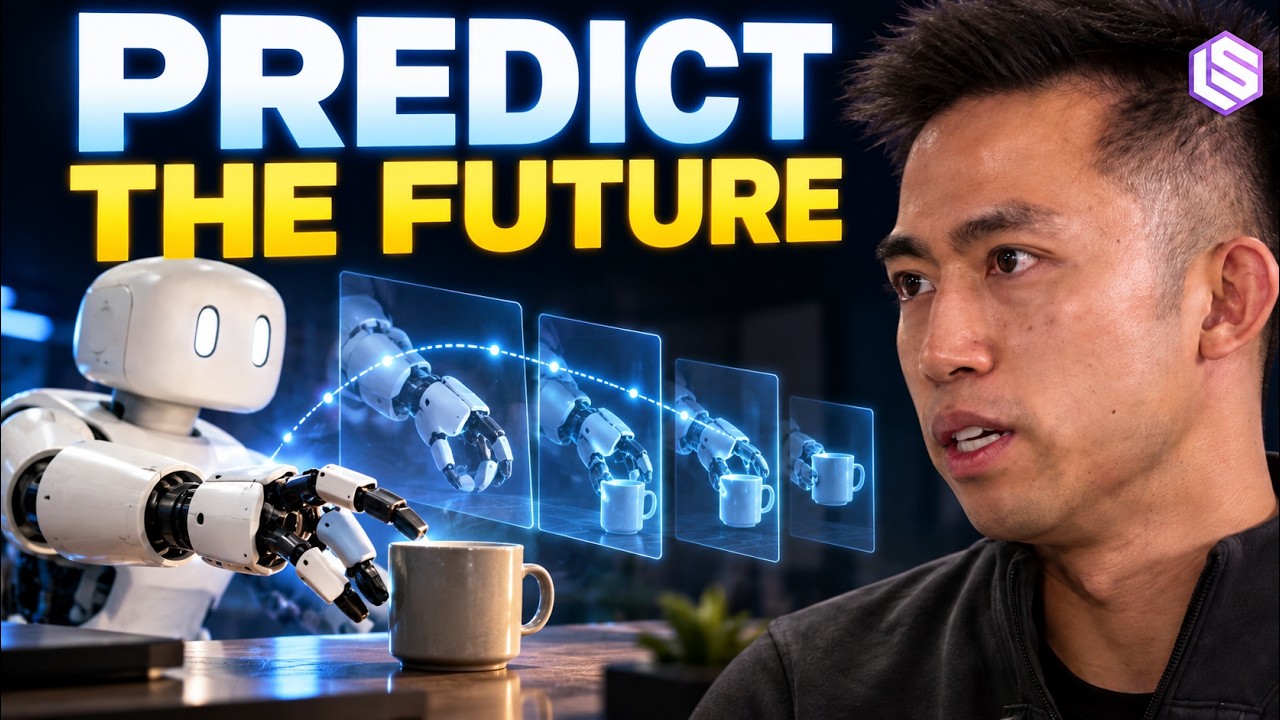
A world-action model is a model that predicts future video, meaning the future state of the world, and also emits the actions a robot executes. Ma frames this as a kind of chain of thought in visual and physical space: the model reasons about how the scene will evolve under a candidate action before producing the motion. He says this makes the model more dexterous, more robust, and better at generalizing to unseen environments and scenarios than approaches that map inputs straight to actions.
The inputs are video from the robot's cameras over the past several seconds, joint angles read from the robot's actuators and encoders, and a language instruction describing the task. The outputs are the action commands, plus future video or a representation of it. Architecture-wise, Dyna-2 is a diffusion transformer built on an encoder-only transformer backbone. The transformer ingests large amounts of data; the diffusion process iteratively refines noisy samples into smooth, precise output, which matters because robot actions must be executed cleanly, much as generated images need sharp edges. Ma notes the broader field has converged on this pattern for robotics foundation models.
Flow matching, which Ma describes as a simpler-to-tune special case of diffusion, replaces the scheduler tuning that diffusion normally demands and works about as well. Applied to action generation, this is where the efficiency comes from: the number of sampling steps can drop dramatically, from the dozens typical of diffusion to a handful, which matters because a robot arm has to close the loop in real time and can re-evaluate as it moves.
The operating recipe is a large generalist base model plus light adaptation. Dyna pre-trains on as much human data as it can find, then fine-tunes on a small number of demonstrations so the robot can pick up a specific task, which Ma says can take as little as 45 minutes of demonstrations. Attendees saw this on a laundry-folding robot given an unfamiliar towel, and on a task pulling drinks from a fridge.
Data is, in Ma's framing, the central constraint. Robotics has no equivalent of the internet, so every company building models or hardware has to source data itself. Dyna collects its own robot data in-house, but Ma argues no single company can gather enough alone, comparing it to trying to build the internet with one large website. The company has opened a data partnerships address, datapartnerships@dyna.co, for vendors with egocentric human video, robot data, or other footage.
Data quality, he says, is non-stationary: what counts as high-quality data shifts as the model improves, and early on almost any video is useful. Egocentric human video makes a strong pre-training prior because it spans nearly every physical activity a person performs, but it leaves a gap until a robot matches human embodiment, so robot-specific data is still needed for low-level dexterity. The intended blend puts broad human priors and robot reflexes into one model.
Deployment evidence is the other half of the pitch. Ma cites a 99.4% success rate folding restaurant napkins for 24 hours straight, including recovering after the robot pulled over an entire stack. Dyna's robots fold thousands of napkins daily at Din Tai Fung. Best Western is also named as a customer site. These are presented as production deployments rather than pilots, with the distinction between the two framed as what separates durable robotics businesses from the field's many failures.
Hardware is part of the story. Dyna builds its own robots rather than buying off-the-shelf humanoids, and chose a wheeled semi-humanoid form factor over bipedal designs. Ma points to dexterous hands that overheat as a real hardware bottleneck, and to missing sensory data as another. On-device inference and model distillation are described as necessary for real-time control. Agentic harnesses, software layers that sequence multi-step work, are what let a robot carry out workflows lasting an hour or more.
Ma also positions world-action models against vision-language-action models, arguing that vision alone may not be enough for physical manipulation. Synthetic environments and self-generated training data are presented as the likely route to the next wave of progress, in keeping with a scaling-first view he calls the bitter lesson of robotics. His own path ran through AlphaGo, Penn, NVIDIA, Google DeepMind and the Eureka project before founding Dyna.
Why it matters: teams building embodied AI now have a concrete reference point for the world-action recipe, with architecture details, a data strategy and a claimed production success rate attached to it, which makes the world-action versus VLA comparison testable rather than abstract. The 45-minute adaptation claim, if it holds broadly, would change how robot deployments are scoped: fine-tuning per task becomes cheap relative to hardware and data collection. The caveats are that the headline figures concern a narrow task, napkin folding, and that hands, sensors and on-device compute remain constraints no model release resolves. A likely trade-off, as an inference, is that the human-video prior buys generalization while leaving an embodiment gap that only robot data closes.
Based on reporting from the original publisher. Visit the source for full context and later updates.
Publisher excerpt
Our first robotics pod with Dyna’s Chief Scientist on their big bet on World Action Models & the Next Frontier of Physical AI