Gemini Omni 1.2 Flash: Fast and cost-effective with longer clips
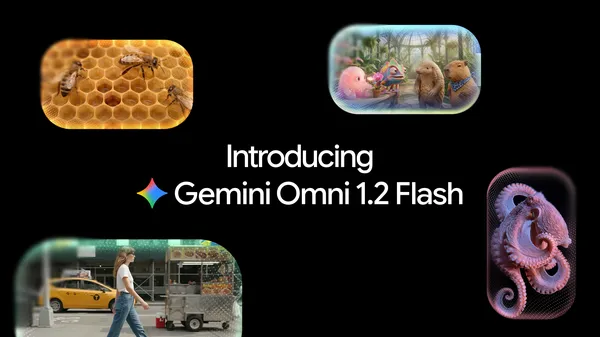
Google DeepMind has rolled out Gemini Omni 1.2 Flash, a video generation and editing model announced by product manager Anish Nangia. The model is generally available starting today across the Gemini API, Google Cloud, Google Vids, and Gemini for business. According to Google, this marks the first time Gemini Omni is generally available, backed by Google Cloud's enterprise infrastructure and security, with Provisioned Throughput offered and outputs carrying an imperceptible SynthID watermark.
The headline change is clip length. Omni 1.2 Flash generates video natively up to 15 seconds, up from the 10-second ceiling on Omni 1.1. Duration can be set in one-second increments from 3 to 15 seconds, which Google frames as enough room for complete stories, product explainers, or full social ad spots in a single generation.
Pricing is the second major shift. Google cut the price by 30% relative to Gemini Omni 1.1, landing at $0.07 per second for 720p video. The workflow is also designed to keep costs down: teams can draft quickly at 360p or 720p, fix a detail with a follow-up edit rather than regenerating an entire clip, and then upscale their best results to 1080p or 4K. For a developer doing the arithmetic, a full 15-second 720p generation at the stated rate works out to roughly $1.05, though the source only gives the per-second figure, so actual billing for drafts, edits and upscales may differ.
Reference adherence is another area of improvement. The model can take a combination of character, product or style images, short motion clips of up to three seconds, and audio cues, and hold those details from start to finish. Google says faces, garments, packaging typography and brand colors stay consistent across camera angles. In practice, this targets workflows like turning existing product photography or character sheets into virtual try-on clips, catalog spins and branded ads. Google illustrates it with a generated 15-second try-on sequence built from one model photo and front-and-back shots of three outfits, spanning 360-degree turns and match cuts while preserving the model's identity and each garment's cut, drape and back details.
Consistency across a shot is the third theme. Google claims stronger character, object and scene coherence from first to last frame, with less visual drift or morphing across motion and camera transitions, including when interpolating between first and last keyframes or extending a clip. A side-by-side example compares 1.1 and 1.2 on a static studio lighting exhibition poster with a five-layer animation prompt, with the newer model rebuilding the poster layer by layer, including ribbed glass, warm filament, faceted crystal and coiled-cord letterforms, and holding material, shadow and typographic detail through the final frame.
Editing moves into conversation. Multi-turn editing lets users refine the same clip turn by turn, swapping a product or background, changing lighting or weather, or switching aspect ratio without starting over. This applies across full 15-second clips. Google demonstrates it by swapping a background scene by scene, from a striped pavilion tent to an oak forest, a stable with a white horse, a market fair and a stone castle, while keeping characters' performances, armor reflections and framing intact. For product teams, that is the piece that most resembles an iterative design loop rather than one-shot prompting.
Speech and camera control get attention as well. Google says dialogue sounds more natural with clearer lip-sync and distinct multi-speaker conditioning, which matters for multi-character scenes in Flow, video explainers in Gemini for business, and avatar-led videos with music and narration in Google Vids. One demo routes four sampled voices to the right characters from a single conservatory scene image plus character, mouth and one-second voice references. Camera work is also described as more controllable, supporting continuous moves such as FPV flythroughs, zoom-outs and orbits with fewer unwanted jump cuts and steadier scale; one example flies from a piazza through bronze doors up to the Pantheon's oculus in a single shot with no cuts.
Availability varies by audience. Developers can prototype in Google AI Studio, use starter apps and consult the API documentation and pricing. Businesses can try it in the Google Cloud console. In Google's own products, users can direct scenes and multi-turn edits in Flow, generate 15-second clips at no additional cost in Google Vids with a Google account or Workspace subscription, create 15-second videos in the Gemini app (rolling out to Google AI Ultra subscribers), and scale campaigns in Google Ads.
Google notes development continues on weak spots including fast sports action, rapid script changes and complex physics. Read broadly, the release positions Omni 1.2 Flash as a fast, cheaper tier rather than a top-end quality model; the combination of low per-second pricing, draft-then-upscale workflow and conversational edits suggests the target is high-volume commercial output like ad variants and catalog footage. A likely trade-off is that aggressive iteration on long clips can still add up in cost, since every turn is another generation, and the physics and fast-motion limits mean action-heavy work may still need review or a different tool.
Why it matters: Teams building video features or ad pipelines now have a generally available Gemini video model with a stated per-second price, 15-second native output, and conversational editing, which lowers the cost of producing many variants from one brief. Developers should expect to rebuild prompts and QA around longer clips, multi-turn edit loops and upscaling, and product managers can weigh the 360p/720p drafting approach against competitor video APIs on price and consistency. Whether the consistency and lip-sync gains hold up in production is something only real workloads will show, which is an inference rather than a stated result.
Based on reporting from the original publisher. Visit the source for full context and later updates.
Publisher excerpt
Text "Gemini Introducing Gemini Omni 1.2 Flash" surroudned by images of a beehive, animals in conversation, a squid, and a woman walking down a street Gemini Omni 1.2 Flash brings native 15-second video generation and editing, stronger consistency, and 30% lower pricing.