The $15 billion ad-powered AI startup your doctor may already be using
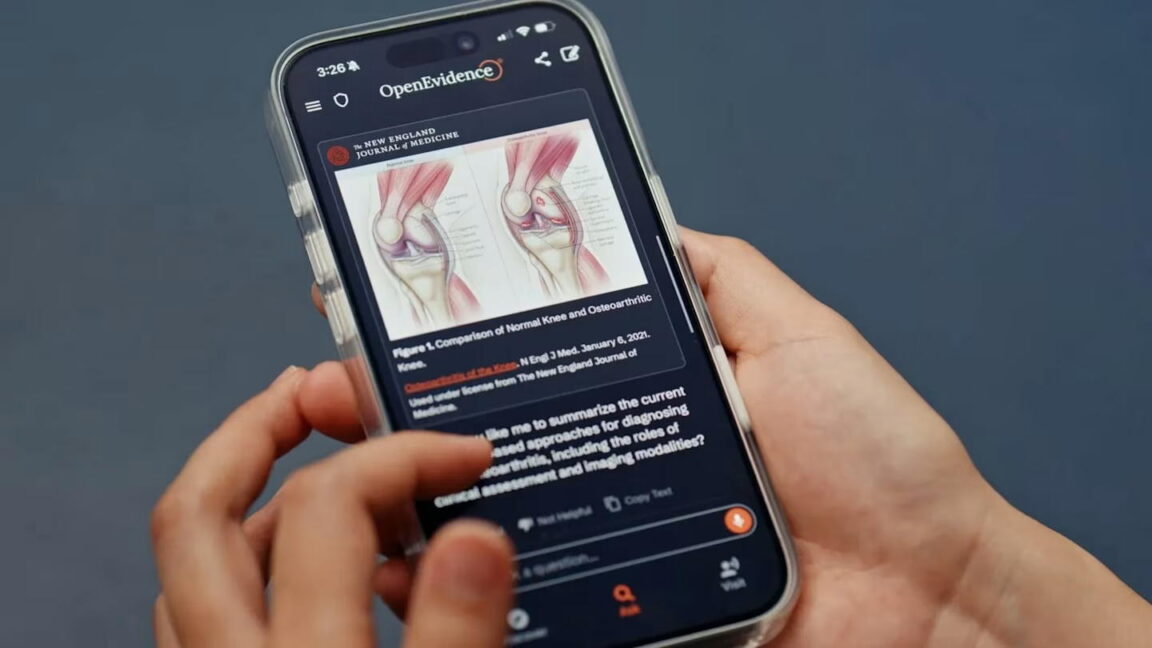
OpenEvidence, a Miami-based startup founded in 2022 by serial entrepreneur Daniel Nadler, has reached a $15 billion valuation on the strength of adoption by US physicians. The company said that doctors across America's roughly 1 million-strong physician workforce ran more than 42 million prompts through its system last month, and that nearly two-thirds of US doctors now turn to the AI-powered search engine when making patient decisions. The company raised $250 million in its latest funding round in September, part of nearly $1 billion in investment over the past 18 months from backers including Andreessen Horowitz, Blackstone, Thrive Capital and Sequoia.
The product is a chatbot aimed at clinicians rather than patients. Doctors use it to search medical journals and clinical guidelines when diagnosing and treating patients, and its core pitch rests on a deliberately narrow source list: peer-reviewed publications such as the New England Journal of Medicine and the Journal of the American Medical Association. Growth has come largely by word of mouth, which Nadler characterized to the Financial Times as making OpenEvidence the first viral consumer internet app in healthcare. Nina Singh, a medical resident at the University of California San Francisco, described using it to supply context about a patient, locate information and reach decisions faster.
The business model is advertising. OpenEvidence booked $100 million in ad buys, a metric covering current and future advertising commitments, for this year as of the end of 2025, according to a person close to the company, and is on track to generate between $400 million and $500 million through ads by the end of 2026, that person said. That trajectory is central to how investors justify the valuation, and critics have questioned whether an ad-based model supports it. This suggests a structural tension worth watching: the users are physicians, the buyers are advertisers, and the two groups' interests are not automatically aligned.
Institutional adoption has followed the grassroots usage. OpenEvidence has relationships with hospital systems and specialist clinics including Mount Sinai Health System and Memorial Sloan Kettering Cancer Center in New York, where the tool is embedded within electronic health records. Paul Testa, chief health informatics officer at NYU Langone, said the system pursued a formal tie-up after finding clinicians already using OpenEvidence as an independent resource, and chose to integrate a clinically informed version into the care process so clinicians could get the most from the tools while using them securely. In practice, that pattern, staff adopting a tool before IT sanctions it, is a familiar route for software into clinical settings, though it inverts the usual procurement order.
The company is also expanding beyond search. It has moved into ambient documentation, the note-taking that happens during doctor-patient interactions, and Nadler said clinical trials will launch in the coming weeks with researchers targeting cancer and rare diseases. The longer-term plan is to apply AI models to drug discovery, generating hypotheses from existing scientific literature. Nadler framed literature-based drug discovery as the end game and said its economic value would dwarf by orders of magnitude whatever the company could charge hospitals or advertisers. Alexander Tarashansky, creator of Anthropic's Claude Science research platform, has joined to support the clinical work.
Evidence on accuracy is mixed. A Mayo Clinic study, and the Mayo Clinic is an investor, found the tool provided accurate, evidence-based recommendations across all five patient case studies sampled, though its effect on treatment decisions was more limited. A June paper in Nature found it underperformed general-purpose models including Google's Gemini and OpenAI's GPT on clinical benchmarks. Nadler's response was that benchmark competition is friendly pressure, and that there is no question of which AI tool physicians trust and use. Eric Oermann, a neurosurgeon at NYU Langone, pointed to a lack of research on how individual AI tools perform and little guidance on implementing them clinically. There are also concerns that junior doctors could lean too heavily on such systems before mastering basic knowledge of conditions and their treatment options.
The competitive field is filling in. OpenAI has made a push into healthcare with ChatGPT for healthcare, and Anthropic has released healthcare tools, though it recently partnered with OpenEvidence to bring tools to 100 low- and middle-income countries. Incumbent medical software has been slow to add generative AI: Wolters Kluwer released an AI version of its subscription UpToDate tool in October 2025, nearly two years after OpenEvidence entered the market. OpenEvidence withdrew from the EU and UK earlier this year over the bloc's AI Act, limiting its reach in two major markets. Mike Vernal of investor Conviction argued that physician popularity is the company's strongest defense against rivals, and Thrive Capital's Nworah Ayogu said doctors adopting software of their own volition signals real differentiation.
Why it matters: Developers and product teams building in regulated, high-stakes domains are watching a rare case of bottom-up adoption beating top-down procurement, with ad revenue rather than software licenses funding the product. The mixed benchmark results and the absence of clear clinical implementation guidance mean teams integrating such tools into EHRs will need their own evaluation and governance, and my inference is that hospital IT groups will increasingly be asked to vet tools clinicians already use. The pending EU and UK exit also shows that regulatory posture can narrow a fast-growing product's market.
Based on reporting from the original publisher. Visit the source for full context and later updates.
Publisher excerpt
OpenEvidence is booming despite questions about accuracy and ads.