Crossing the Threshold: How OpenAI and Anthropic Approach Autonomy and Safety in Financial Agents
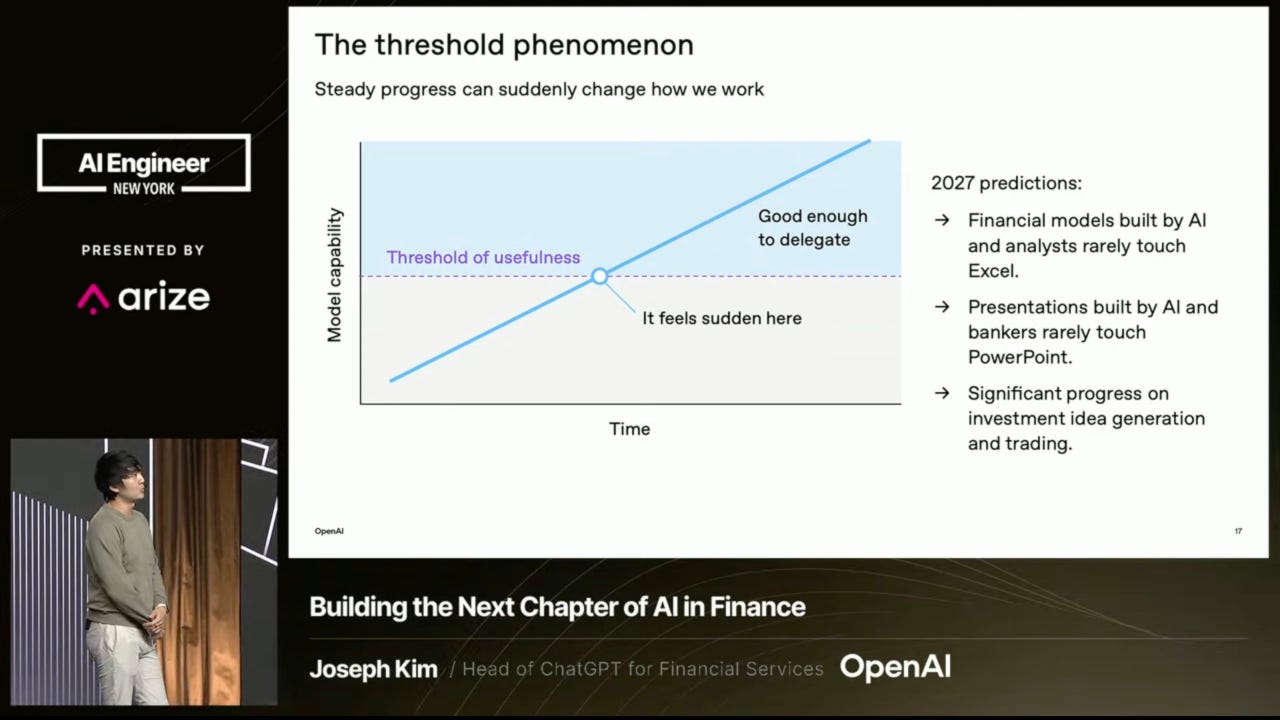
Joseph Kim, Head of ChatGPT for Financial Services at OpenAI, gave a keynote at the AI Engineer New York conference today, where he framed progress in financial agents around what he called a "threshold of usefulness": the point at which a model becomes capable and reliable enough to save a user time. The talk sat within a broader conference theme of balancing agent autonomy against security and safety, a subject that both frontier labs and financial firms addressed in their presentations this week. Latent Space also recorded a separate podcast with Kim, which it says will be released shortly.
Kim's core argument is that growing model capability will soon carry financial analysts past that threshold, letting them hand more of their work to agents. He made concrete predictions for 2027: the industry will lean less on Excel and PowerPoint, and agents will be good enough to perform investment idea generation and trading. Those are forecasts rather than shipped features, and the source does not detail how such capabilities would be scoped or supervised, so they should be read as a directional claim from a lab executive rather than a roadmap commitment.
A second thread was traceability. Kim said that in finance you need to be able to check where a number came from and understand its context, and that OpenAI wanted that review step to be a natural part of the ChatGPT for Financial Services experience. He described these as the kind of product details that convert raw model capability into work someone can actually use. This is the more actionable part of the talk for builders: sourcing and review are product surface, not an afterthought bolted on after the model is chosen.
The headline lesson drawn across the conference was that safe autonomy depends less on how many restrictions you impose and more on where you place controls and human judgment. That framing is worth unpacking for anyone building agents with financial workflows. An agent that can pull data, compute a figure and draft a recommendation has two separable problems: whether each step is correct, and whether a human can audit the chain afterwards. Restriction-count thinking tends to attack the first by blocking actions; placement thinking attacks the second by putting approval gates, provenance records and review steps at the points where an error would be expensive. In practice, a likely trade-off is that heavy gating at every step costs the very time savings that define Kim's threshold, while too little gating makes outputs hard to defend in a regulated setting.
Traceability also has a technical shape. Provenance generally means capturing which sources, queries and intermediate values produced an output so a reviewer can reconstruct it, which implies structured tool calls, logged retrieval and stable references to data rather than free-text reasoning alone. Developers building on general-purpose chat models will likely need to supply that scaffolding themselves unless the host product exposes it, which is one reason a vertical offering like ChatGPT for Financial Services is interesting: it can bake review into the interface instead of leaving it to each customer.
The 2027 trading prediction sits furthest from current evidence. Idea generation is a text-and-analysis task where an agent can plausibly contribute drafts and comparisons while a human decides. Trading implies execution authority, where errors are immediate and monetary, and where autonomy and control placement collide most directly. Kim's threshold framing implicitly acknowledges this: usefulness is defined by reliability, and reliability in execution contexts is a higher bar than reliability in drafting. The source does not describe safeguards for trading agents.
Why it matters: Teams building finance-adjacent agents should expect buyer questions to shift from "what can the model do" to "can I see where this number came from and where a human signs off." If Kim's threshold argument holds, the competitive edge moves to provenance, review flows and control placement rather than raw capability, and product teams should design audit trails into the agent loop early. Whether agents reach trading-grade reliability by 2027 is, in this reader's inference, the least certain part of the forecast.
Based on reporting from the original publisher. Visit the source for full context and later updates.
Publisher excerpt
At AI Engineer New York, frontier labs and financial firms explored how to give agents useful autonomy while keeping consequential decisions under control.