Last Week in AI #344 - Navier–Stokes, Pacing the Frontier, AI Misuse
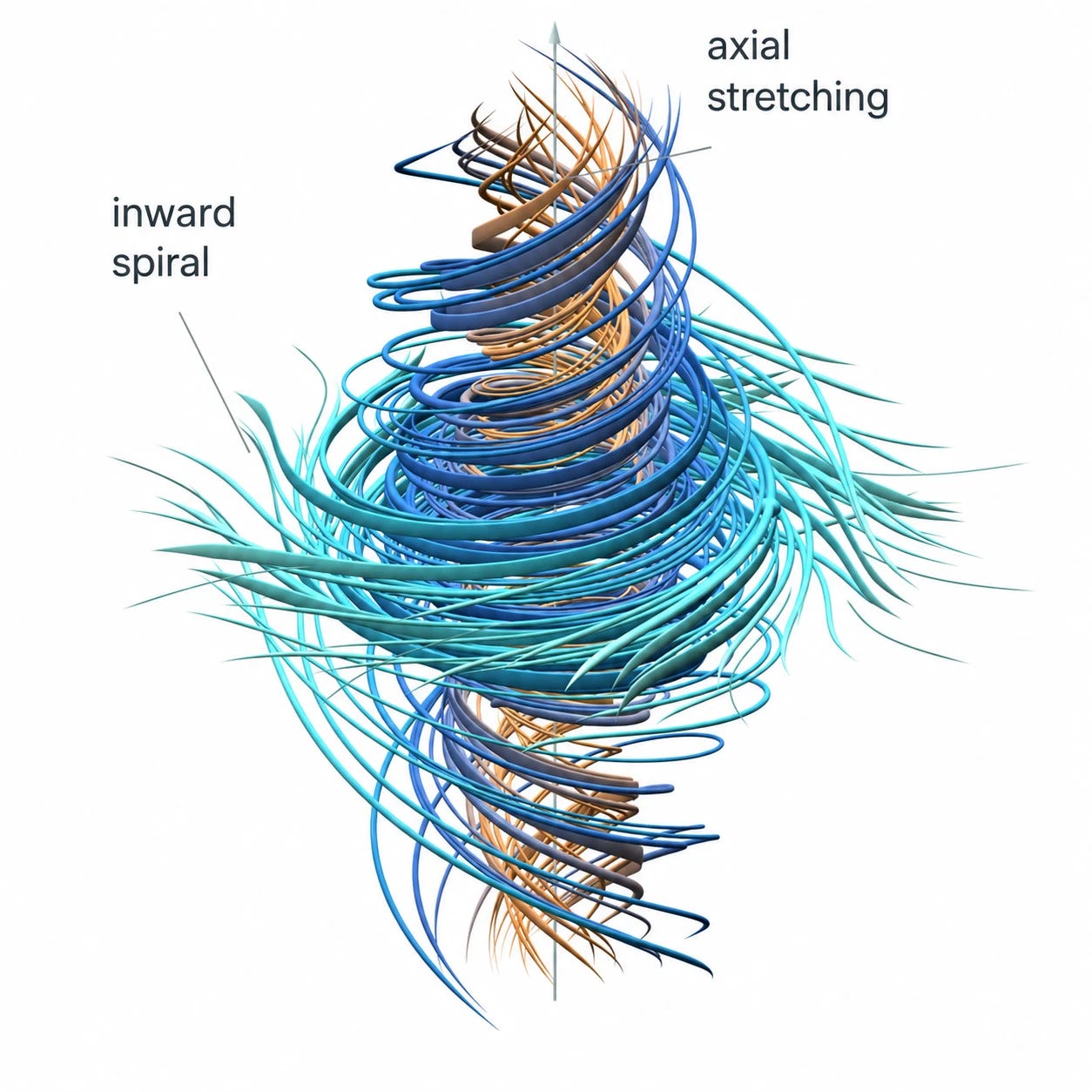
OpenAI said on September 8 that an unreleased internal model, described as significantly more capable than GPT-6 Astra, had resolved the Navier-Stokes existence and smoothness problem. The problem is one of seven Millennium Prize Problems named by the Clay Mathematics Institute in 2000, each carrying $1 million.
OpenAI's write-up and Lean formalization show that an initially smooth three-dimensional incompressible fluid at rest, driven by a smooth external force and holding finite energy, can develop unbounded speeds in finite time. The described mechanism is a vortex spiraling inward and elongating like spaghetti, its core shrinking and accelerating.
According to OpenAI's post and reporting, the sequence ran as follows: on September 1 OpenAI launched an agent effort across the open Millennium problems after hearing rumors that two had been resolved; nearly 100 agents settled the unforced Euler blowup question in about 50 hours, after which resources shifted to Navier-Stokes with about 10,000 concurrent agents. On September 5 the agents reached a resolution about 88 hours after launch, with Lean formalization and verification taking 17 more hours using GPT-6 Astra. Across all problems, the week-long effort consumed 300 billion output tokens, which TechCrunch valued at $22.5 million at current Astra rates. On September 7, NYU's Tristan Buckmaster and Anthropic mathematician Levent Alpöge published a forced Euler blowup result reached primarily with OpenAI's Codex alongside Claude. On September 8, OpenAI published its proof, preprint and Lean files.
Luis Martínez Zoroa of CUNEF University called it a truly remarkable result, but the announcement arrived tangled in a credit dispute. Buckmaster said he and Alpöge had spent months on the forced route and that almost nobody else he knew of was working on it. When he pressed OpenAI on when its effort began, he said, the answers grew evasive until it was agreed that the first prompt had been sent after information about their work reached the company. Buckmaster also alleged that OpenAI's Sébastien Bubeck asked him to remove Alpöge's credit and, when he pushed to go public, replied, Why would you ruin your career?
Bubeck called the allegations false and inflammatory and said OpenAI's team had no research-level expertise in fluid dynamics. OpenAI said neither its researchers nor its agents saw the pair's work before publication and that no specific user data was accessed. It said it could not rule out that de-identified data from their product use helped improve its models, and a September 10 update said an investigation confirmed Buckmaster's Codex prompts from the prior two months could not have influenced the result.
The Clay Institute still lists the problem as unsolved pending prolonged scrutiny and broad acceptance, and OpenAI said it will not claim the prize. Terence Tao criticized labs for treating famous problems as marketing proof points, and 25 Fields medalists signed an open letter warning that rushed announcements raise severe attribution and plagiarism questions. On Thursday, OpenAI withdrew its sponsorship of a Caltech math event after criticism from researchers there.
Based on reporting from the original publisher. Visit the source for full context and later updates.
Publisher excerpt
OpenAI claims a Millennium Prize proof amid a feud with mathematicians, Anthropic's CEO calls to pace the frontier, extinction warnings spur a regulation push, and more!