[AINews] Meta Muse Wonder & Wonder Full: MSL’s Claude 5.5-tier Frontier Model
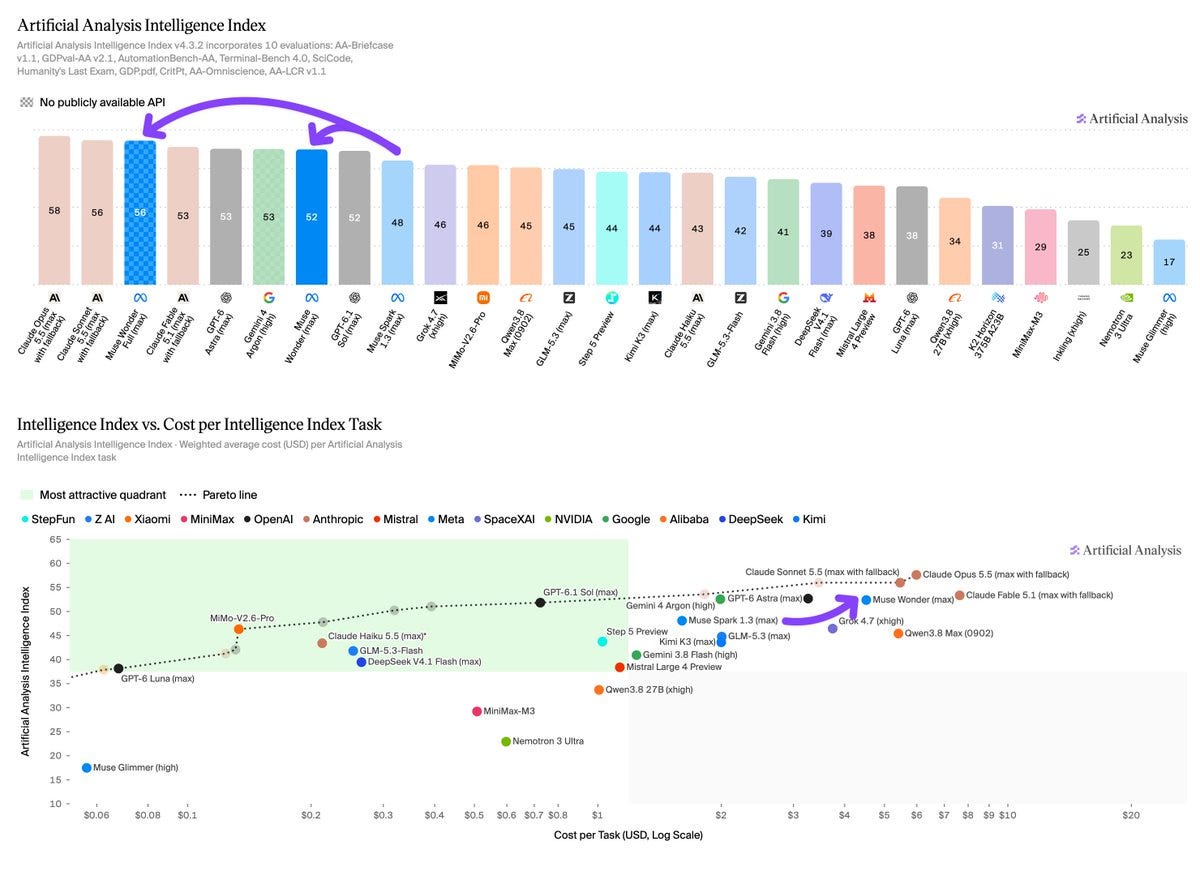
Meta Superintelligence Labs shipped Muse Wonder and Muse Wonder Full, its second-generation model family, codenamed Watermelon. The launch was announced by Mark Zuckerberg and Alexandr Wang and lands roughly 14 months after MSL was founded; Muse Spark, the lab's first family, arrived in April, and third-party evaluations place the new models near the frontier according to the reporting. Meta describes them as a much larger and more advanced class of models than Spark.
The family splits into two releases with different access rules. Muse Wonder, the fast frontier tier, is available through the Meta Model API and Muse Code, and will power the Muse personal-agent product for subscribers first. Muse Wonder Full, the maximum-reasoning tier, is restricted to Muse Code subscribers on Power or Maximum Usage plans. Muse Code installs with a single curl command against dev.meta.ai. Specs are shared across the family: a 1M-token context window, input in text, image, video and audio, and text-only output. Pricing is $4 per million input tokens, $0.20 per million cached input tokens and $20 per million output tokens. Wonder Full has no published token price, so a per-task cost cannot be computed for it.
Meta positions the models as state of the art for personal and professional agentic work and highlights three features: Active Memory, which retains context across days, weeks and months; Active Focus, aimed at working through blockers until a task finishes; and domain expertise, claimed as SOTA in finance and legal and strong in health. Wang says Meta continued scaling both pre-training and RL since April. Meta says the family was trained for robustness to adversarial instructions and careful handling of private information, though no detailed system card accompanied the release.
The launch was bumpy. Wonder and Wonder Full drained Muse Code quotas abnormally fast on launch day, prompting a same-day fix and a quota reset for all users. Wang acknowledged there were still issues being ironed out. Separately, Zuckerberg and Wang appeared on Stripe's Cheeky Pint podcast, covering topics including a $100B bet, agentic commerce and why AI won't be winner-take-all.
Artificial Analysis published the most detailed independent read. On Intelligence Index v4.3, Wonder Full at max reasoning scores 56 and Wonder at max scores 52, up from Muse Spark 1.3's 48; just six weeks separate Spark 1.3 and the Wonder releases. Opus 5.5 leads the index at 58. Wonder Full improved on all ten index evals, with the largest gains in agentic work: Terminal-Bench 4.0 rose from 33% to 57%, GDPval-AA v2.1 from 1681 to 1857 Elo, and AA-Briefcase from 1581 to 1729 Elo. Wonder Full lands in the top three on six of ten evals, taking first on two of them at 33% each, second on GDPval, and third on AA-Briefcase, AutomationBench-AA at 71% and SciCode at 63%. The non-Full Wonder went from 33% to 52% on Terminal-Bench and 58% to 68% on AutomationBench.
Token economics are a recurring theme. Both models use roughly 54k output tokens per index task, about 10% below Spark 1.3's 60k, against 62k for Gemini 4 Argon, 78k for Fable 5.1, 38k for GPT-6.1 Sol and 27k for GPT-6 Astra. Input usage runs 6.44M for Full and 7.69M for Wonder. Wonder's cost per index task is $4.52, high because of that input volume; the same table lists Fable 5.1 at $7.63, Opus 5.5 at $5.98, Sonnet 5.5 at $5.46, Astra at $3.26, Argon at $1.99, Sol at $0.72 and Spark 1.3 at $1.60. In the Coding Agents Index, Wonder Full inside Muse Code scores 68, tying Claude Code with Sonnet 5.5 and edging ahead of Opus 5.5 at 66; Wonder scores 63 against Spark 1.3's 54.
Vals AI found Wonder Full at max reasoning fifth on the Vals Index, up 6.4 points over its predecessor and ahead of every OpenAI model listed. On its private ProofBench it scored 94 out of 100 against 58 for Spark 1.3, with top models at 99-100, and more than doubled Terminal-Bench 4. Vals also reported efficiency gains: roughly 30% fewer output tokens on Terminal-Bench, 40% fewer on ProofBench and half the steps on Vibe Code Bench at the same score. Wonder placed tenth, up 7.9 points, at about 37 minutes per task versus 57 for Full, and scored 62.6% on Code Migration. Meta's own headline numbers, relayed by third parties, include SWE-Marathon at 57.5% against Opus 5.5's 46.3% and GPT-6 Astra's 42.5%, DeepSWE v1.1 at 79.0% against Opus's 74.2% and Astra's 74.1%, Harvey LAB at 13.1 against Astra's 8.6, and MemoryBench at 85.5 against Opus's 81.5. Other signals include Claudine confirming Wonder leads DeepSWE, strong ProgramBench results, HealthBench Pro on par with Fable 5.1, favorable Perplexity WANDR results and pending Arena scores. Meta's stock rose 3% on the day.
Reactions split. One practitioner with early access ranks it S-tier alongside Opus 5.5 and above GPT-6.1 Sol, praises distinctive prose and agents.md compliance, and uses it for code and architecture review alongside Opus while not recommending replacing Opus. Another reported it resists trick questions, follows instructions precisely and self-checks code, but described creative writing as a bit dry, and stressed a roughly 60% price undercut versus Fable 5 at $10/$50. One tester placed Full above Astra but below Claude Code Fable and Opus 5.5, though faster and better at compiler work, while another called it strong at agentic tasks, coding and email but weak at frontend design, SVG, video and creative work. Skeptics estimate Meta remains about three to six months behind OpenAI and Anthropic, question the lack of a detailed system card, and note that Full being subscriber-only with no published price complicates comparison. One observer called the two variants very different models, with Full matching Opus at high reasoning on fewer tokens while Wonder scores below GPT-6.1 Sol. A partner note called token efficiency the biggest unlock and reported zero refusals on cyber benchmarks, where Wonder outscored Full, but weaker scientific-discovery intuition.
Context worth keeping in mind: Meta's internal metrics include a Personal Superintelligence Index built instead of chasing external benchmarks, and the team emphasizes non-post-trained versus post-trained performance as evidence against benchmaxxing. A debate also ran about weak early 3D demos; Wang said Meta did not explicitly train on 3D demo games and probably should have, arguing the focus was real-world tasks. The same day, Artificial Analysis launched AA-3D, a three.js benchmark where Claude and Astra models lead.
Why it matters: Product teams now have a frontier-adjacent API at $4/$20 per million tokens with a 1M context window and multimodal input, available broadly through the Meta Model API, while the strongest variant is gated behind a Muse Code subscription with no published price. That split complicates cost modeling for anyone planning to standardize on it, and the efficiency numbers suggest cheaper long agent runs than several alternatives, though the reported ranking below Opus 5.5 on the headline index and the 3-6 month skepticism mean teams should validate on their own workloads rather than trust vendor framing.
Based on reporting from the original publisher. Visit the source for full context and later updates.
Publisher excerpt
MSL’s emergence as a frontier lab is finally complete.