AI R&D Is Accelerating Towards Potential RSI in 2027
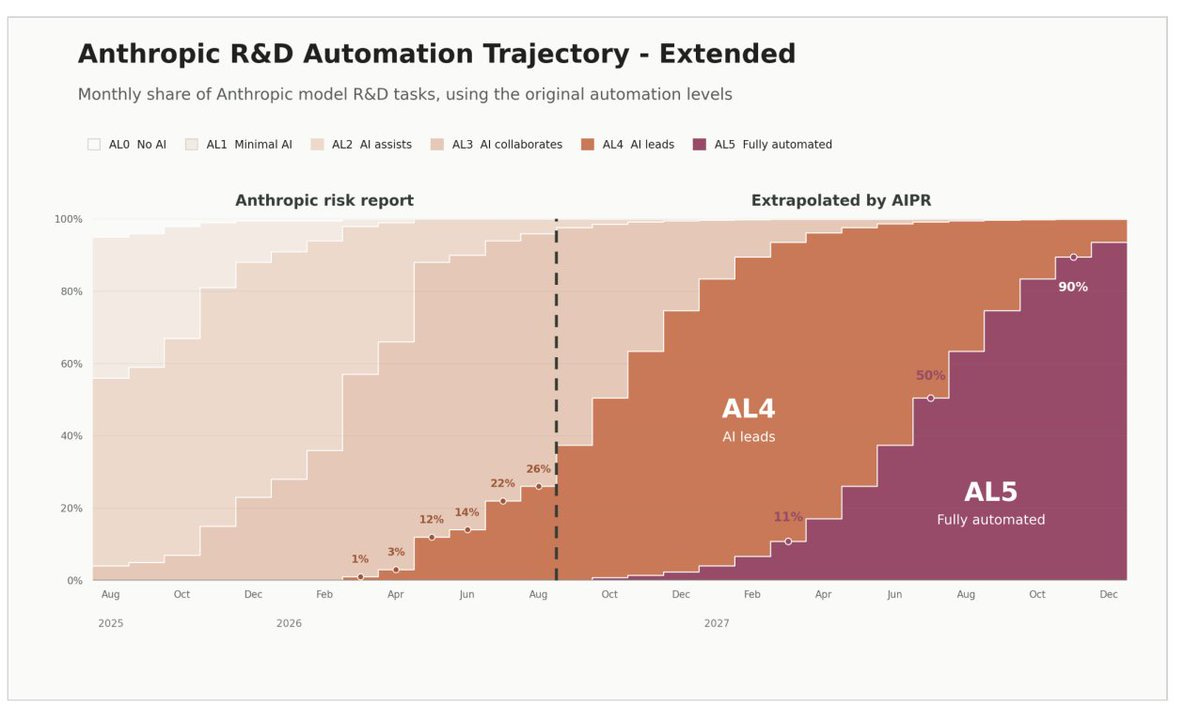
METR published an extensive report examining how much Anthropic's AI systems are accelerating the company's own AI research and development, based on deep access to internal data. In its top-line conclusions, METR states that as of October 2026, Anthropic is likely improving model capabilities on well-specified tasks at around twice the rate seen between March 2024 and October 2025, with a wide uncertainty band spanning roughly 1.3x to 3x the historical pace. METR also judges that a majority of that acceleration is likely attributable to Anthropic's extensive use of AI in R&D, while noting significant uncertainty and that other causes probably mattered a lot in late 2025.
The central empirical finding is that Anthropic's benchmark scores, measured on AECI, the company's fork of the Epoch Capabilities Index, have grown at an estimated 1.9x the pre-October 2025 rate since October 2025, with a 95% confidence interval of 1.5x to 2.8x. That implies Anthropic made roughly two years of historical progress in the last year. METR says it is confident the acceleration was not caused by faster scaling of training compute, ruling out the most obvious alternative explanation.
The methodology matters for reading the numbers. METR measured model dates by when a model became usable by most Anthropic employees rather than by public release, so that unreleased internal models could be compared on equal footing. Emphasizing internal rather than public models raises the estimate: the report notes that adding recent internal releases takes an earlier figure of about 1.7x from the Haiku system card to roughly 1.9x. In practice, that means tracking only publicly available models can paint a slower picture of progress than the internal record shows.
Interviews and surveys back up the quantitative picture. Anthropic staff self-report dramatic uplift from using AI systems, though METR cautions that such reports are hard to interpret. Staff also said R&D is currently accelerated mainly through AI assistance rather than fully autonomous contributions, with some signs that autonomous contributions will take on a larger role soon. Whether acceleration comes from humans assisted by AI or from systems working independently is an important distinction for anyone forecasting how fast the loop could tighten.
On bottlenecks, METR reports finding no evidence of limits on algorithmic progress, training compute, experiment compute or data that would block further acceleration over the next 12 months. It adds a caveat: its understanding of the status of different bottlenecks shifted several times as more detailed information arrived, so it is not confident in that assessment. METR's own framing of the risk is that the absence of observed bottlenecks or strong diminishing returns means further progress could plausibly lead to even faster acceleration, while acknowledging important bottlenecks may have been missed.
Access and redaction shape what the public can check. METR says Anthropic gave unprecedented access, including internal benchmark scores and sample tasks, historical data on algorithmic efficiency in pretraining and reinforcement learning, compute utilization, training compute metrics across domains, headcount and progress attribution, internal surveys of self-reported AI uplift, lines of code and pull requests, agent inference spend, documents on autonomous research contributions, and about 15 staff interviews. Anthropic retained the right to redact, and METR reports that a majority of the evidence it found most informative was removed from the public version of a roughly 100-page report. Anthropic described the redactions as aimed at removing confidential information that could accelerate other AI developers. METR says the result is that the public must lean on its judgment more than it considers ideal.
Among the specific items METR says it could not communicate publicly are detailed acceleration estimates and AI attribution for key parts of the training pipeline, a finer breakdown of progress attributable to compute, data and algorithmic improvement beyond the finding that training compute acceleration was ruled out, forecasts of future model metrics, and more detailed answers on limitations. Redacted material also includes the analysis of various bottlenecks and detail on non-AI factors behind the late-2025 acceleration, which METR guesses accounts for perhaps 20% of the current effect.
Reaction from METR staff has been blunt. Ajeya Cotra said the report and Anthropic's responsible scaling policy together suggest the threshold for dramatic acceleration has already been crossed, and that she made only minor updates toward faster timelines because she had already made larger ones. She noted that METR's own team did not expect substantial acceleration, and pointed to earlier expectations of a 1.15x to 1.3x speedup this year from Ryan Greenblatt and an estimate of at least 1.5x in the Opus 5.5 system card six weeks earlier. Peter Wildeford drew out the implication that labs hold stronger unreleased models and run them with vastly more compute than outside users. Benjamin Todd, extrapolating Anthropic's internal R&D data, puts Claude leading internal research by mid-2027 and plausibly near full automation by the end of 2027.
That extrapolation is where the recursive self-improvement question comes in. RSI in this context means AI systems contributing enough to AI research that each generation makes the next cheaper to build, tightening the loop. METR's findings sit several months ahead of the AI 2027 forecast, and the report moved many readers toward shorter timelines. The commentary is careful to name the ways this could fail to hold: the estimates could be wrong, bottlenecks could appear, results could prove narrower than expected, or labs could choose to stop. METR's own uncertainty ranges and its warnings about redacted and ambiguous evidence are the concrete grounds for treating the extrapolations as scenarios rather than predictions.
Why it matters: developers and product teams should expect internal capability curves at frontier labs to run ahead of what public model releases suggest, which affects how quickly planned features become cheap or obsolete. If METR's read is right, the compute and access gap between labs and outside users widens the practical distance between the best internal systems and what any customer can call, though that is an inference from the report's own framing rather than a stated claim. The redactions also mean outsiders, including policymakers, cannot independently audit the strongest evidence, so third-party benchmarks and public evaluations will keep understating the frontier.
Based on reporting from the original publisher. Visit the source for full context and later updates.
Publisher excerpt
METR came out with an extensive report on how much AI is accelerating AI R&D at Anthropic, and thus how close we might be to recursive self-improvement (RSI) and how far that might go.