How Greenlight Financial built an autonomous SOC solution on Amazon Bedrock AgentCore
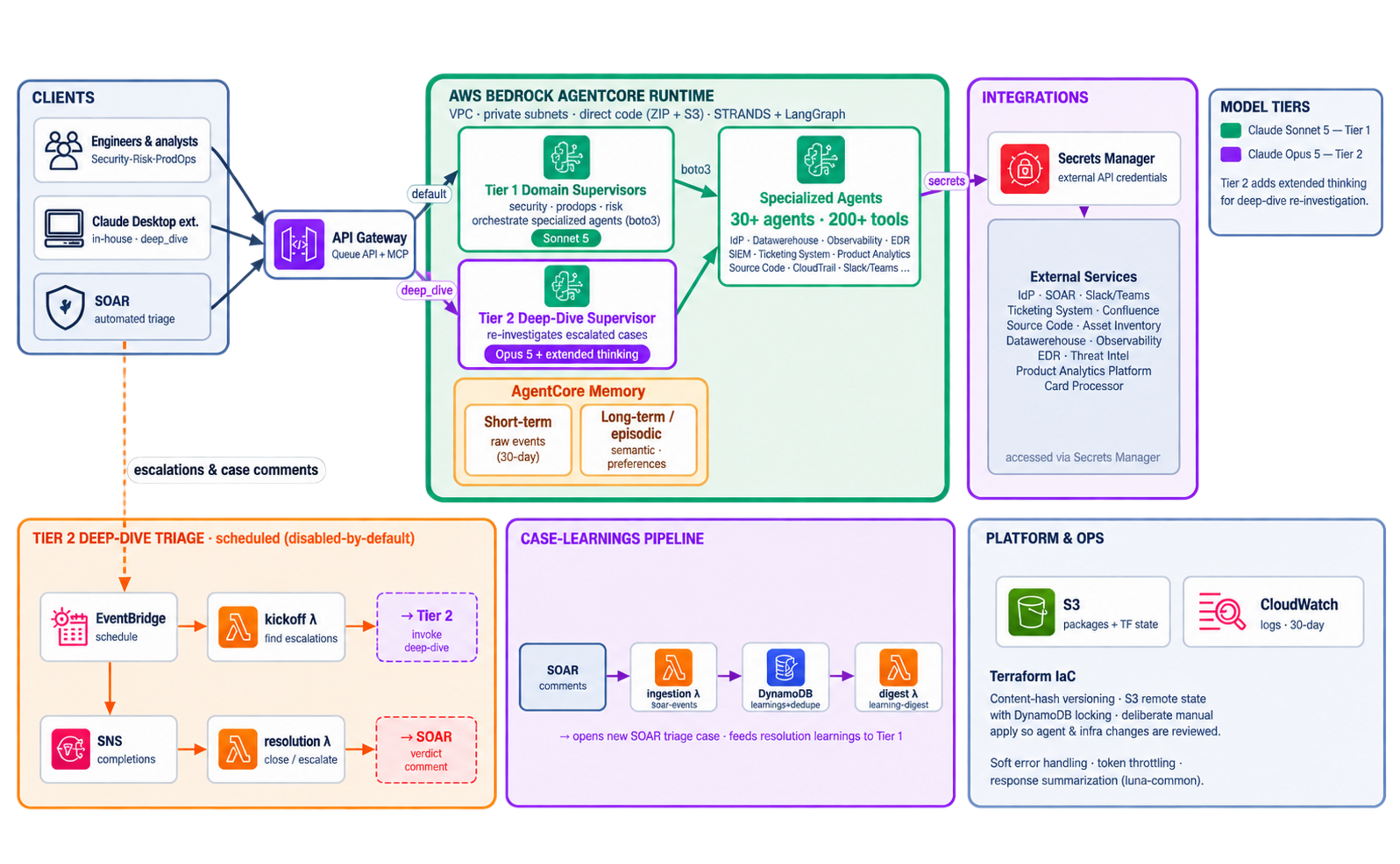
Greenlight Financial, a company offering debit cards, savings tools and connected devices for families, has built an autonomous security operations center (SOC) agent called Luna on Amazon Bedrock AgentCore. According to the AWS Machine Learning Blog, Luna now resolves more than 90 percent of the company's 3,000 to 4,000 monthly security and risk cases without human intervention, after starting at an 83 percent rate with Tier 1 automation alone. Median triage time for routine cases has dropped from a human baseline of 15-30 minutes to single-digit seconds.
Greenlight operates under the same regulatory requirements as major banks, which shapes how the system is scoped. Cases arrive from four vectors: dark web breach cards flagged by card networks and internal threat intelligence, identity and access anomalies such as unusual logins and privilege escalations, infrastructure alerts from EDR, SIEM and observability tooling, and financial risk events including suspicious transaction patterns and fraud indicators. Resolving a single dark web card notification by hand means checking whether the card is active, deduplicating prior notifications, reviewing session data and opening support tickets.
The architecture is a tiered supervisor pattern that mirrors how human SOC teams are organized. A Tier 1 supervisor runs an advanced language model available through Amazon Bedrock on AgentCore runtime, deployed inside an Amazon VPC with private subnets and code shipped as a ZIP file through Amazon S3. It decides which of more than 30 specialized agents to call based on alert type, synthesizes their findings and returns a verdict. Those agents cover identity and access, endpoint detection, observability, asset inventory, data analytics, payment processing, customer experience, customer support, code repositories, project tracking, threat intelligence and SOAR automation. Cases enter through Amazon API Gateway, which exposes a Luna Queue API and a Model Context Protocol endpoint, and through Tines SOAR for automated ingestion.
Cases that fall below Tier 1's confidence threshold escalate to a Tier 2 supervisor, which uses a foundation model with extended reasoning capabilities. This tier handles roughly the tenth of cases requiring multi-step work: deeper cross-source correlation, agent invocation through boto3 with larger context windows, chained reasoning across three to five data sources, and written investigation reports with evidence chains. Tier 2 runs on Amazon EventBridge rate triggers and Amazon SNS queue completions for batched work, plus on demand for urgent escalations.
Three entry points serve different users: Tines SOAR as the primary volume driver, direct API access for security, risk and ProdOps engineers, and a Claude Desktop extension that lets on-call engineers describe an investigation in chat and get a full deep-dive.
The memory layer on AgentCore memory is what separates Luna from a stateless triage tool. An episodic store keeps a 30-day rolling window of events and outcomes, so a maintenance job that fires every Tuesday at 3 AM gets allowlisted after its first resolution rather than re-flagged weekly. Long-term memory persists resolution templates and semantic preferences past that window, including a rule from historical data that cards from one particular dark web source carry a 73 percent false-positive rate and should be deduplicated first. A case-learnings pipeline captures every resolution through AWS Lambda, stores and deduplicates patterns in DynamoDB, records a confirmed pattern after three identical resolutions, and digests new learnings into context the supervisors read at inference time. Greenlight credits this feedback loop with moving the autonomous rate from 83 percent to above 90 percent.
Within two months of the SOC deployment, Greenlight extended Luna into financial risk triage by adding domain-specific agents and a risk supervisor rather than rebuilding. In the breach-card workflow, Luna ingests compromised card numbers from Mastercard and internal feeds, verifies card status and transaction history against Galileo, deduplicates in DynamoDB, cross-references Mixpanel session data, Zendesk tickets and internal fraud scoring, then sorts outcomes into monitoring, review or escalation with an evidence chain. Greenlight receives hundreds of such notifications daily.
On outcomes, human escalations fell from all cases to 17 percent with Tier 1 and under 10 percent with both tiers. Greenlight estimates that 4,000 cases at 15-30 minutes each would consume roughly 1,000-2,000 analyst hours monthly, and that Luna avoids an estimated 900-1,800 of those hours. The company also cites consistency as a benefit: the same logic applies at 3 AM Saturday as at 10 AM Tuesday.
A deliberate constraint is that Luna triages and recommends rather than acting. Remediation is authorized by a human analyst or an approved automated policy, which Greenlight says satisfied compliance requirements and built trust with the risk team. This suggests a sensible pattern for regulated environments: give agents wide read access and strong reasoning while keeping write actions behind an approval gate, then widen autonomy only where evidence supports it.
Greenlight's stated lessons include starting with a bounded domain with clear pass/fail criteria, mapping the tier structure to existing team roles so staff recognize the escalation logic, reusing agents like those for Datadog, Zendesk and Mixpanel across security and risk to cut maintenance, and letting memory accumulate institutional knowledge. After six months, Greenlight says Luna holds knowledge that would take a new analyst months to build.
Work in progress includes fuller risk-domain coverage, which launched about a month before the post, and exploration of AWS DevOps Agent for incident investigation, root-cause analysis, custom agents, MCP integrations and automated Well-Architected reviews, along with script execution workflows capped at 90 seconds.
Why it matters: Teams building agents for security, fraud or other regulated operations now have a concrete production reference for a supervisor-and-specialist design on managed infrastructure, including how memory and a learnings pipeline can lift automation rates over time. The reported numbers suggest the economics of routine triage shift substantially when routine cases resolve in seconds, though the figures are Greenlight's own measurements rather than independently verified benchmarks. My inference is that the biggest near-term impact will be on smaller security and risk teams that cannot absorb thousands of low-value alerts, provided they replicate the human-in-the-loop controls that made the rollout acceptable to compliance.
Based on reporting from the original publisher. Visit the source for full context and later updates.
Publisher excerpt
Greenlight Financial resolves more than 90% of up to 4,000 monthly security and risk cases without human intervention using Luna, a tiered multi-agent system on Amazon Bedrock AgentCore. This post covers the architecture, episodic memory for continuous learning, and the expansion from SOC operations into financial risk triage.