Claude Mods: Flipping the Harness Inside Out
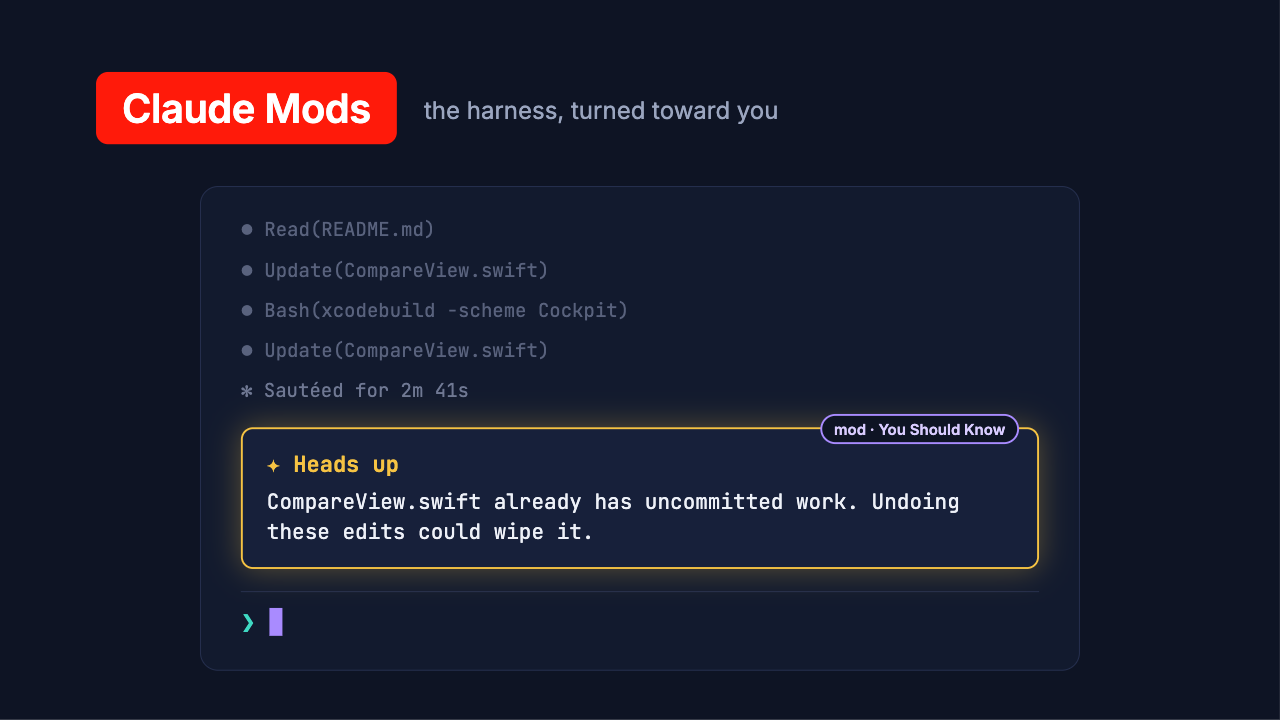
Claude Mods are a plugin system for Claude Code in which a mod is a set of TypeScript or JavaScript functions that run inside the application and customize its behavior and appearance in both the CLI and Desktop clients. They attach to events — a submitted prompt, a tool call, an interface render — and can observe the event, change how it is displayed, or take over handling in place of the default behavior. Latent Space's write-up frames them as middleware for the agent harness: injected code that alters Claude Code's execution and rendering flow while it runs.
The framing behind the piece is what its author calls the Attention Interface. The argument, made in an earlier Latent Space post on the evolution of the agent harness, is that as models absorb more of the harness into their weights, the remaining layer faces the human: it decides when the agent interrupts you, what it shows you, and which decisions it needs from you. Mods are an early, user-shapeable version of that layer. The harness traditionally pointed from the agent toward the machine, translating prompts into commands, file edits and tool calls. Mods point part of it back toward the operator, making the human-facing layer programmable by the person using it. Claude Code also carries a built-in skill that teaches Claude how to write mods, so a user can describe the mod they want in plain language and have Claude build it.
Anthropic already ships six mods built in, visible by running /plugin and opening Installed under a Built-in listing: agents-md, which loads AGENTS.md as project instructions; diff, which takes over /diff and draws its pane; plugin-authoring, which supplies the skill Claude uses to write mods; sec-default, which guards organization-managed settings from mods a user installs; telemetry, which sends the analytics records Claude Code and its built-in mods log; and you-should-know, a side agent that posts a note above the prompt when it spots something you may have missed. Of the six, only you-should-know is off by default. Most run in the background, which suggests Anthropic is assembling parts of Claude Code itself as mods, including pieces users never notice.
The author singles out two mods as most useful in practice. You Should Know watches the main agent while it works and flags tool calls and decisions with a material effect on the output that are buried in the agent trace. In one session, Claude Code was asked to simplify noisy UI text; the main agent trimmed copy on a Compare screen, installed the build and took before-and-after screenshots, and everything looked finished. The mod then flagged that CompareView.swift already held uncommitted work, as did roughly 45 other files, so discarding the demo edits later would also throw away that unfinished work. Its suggestion was to commit or stash first.
The second is Next Steps Supervisor, a mod the author wrote, available as part of ModSmith — an open-source Claude Code plugin containing several built-in mods plus a template Claude can use to write new ones that work together. It runs only after a turn that edited files, ran commands or made eight or more tool calls, surfaces up to six pieces of information for attention, and proposes a next step as a clickable button that sends the instruction to Claude Code as a message. This suggests the pattern developers will hit first: mods that gate themselves on cheap heuristics about when a turn was substantial.
Latent Space compares this with two other products heading the same direction. OpenAI's ChatGPT shipped what it calls an Intelligent UI alongside GPT-6 on October 7, generating charts, maps, checklists, forms and small tools such as a bill splitter or savings calculator as it answers, and in one example replying with multiple-choice follow-ups. The model picks the interface answer by answer from a component library OpenAI built, and the one control mentioned at launch is turning the visuals down. Cursor's PR Routing & Approval addresses the team case: it assigns reviewers from code ownership and commit history, can auto-approve low-risk pull requests, and weighs a risk score against a threshold you set, findings from Cursor's Bugbot and Security reviewers, and policy files in the repo. One rule stands out: if a PR edits an approval policy, the agent reads the policy from the base branch rather than the edited version, so it cannot relax review on its own PR. Cursor's docs say the feature does not replace a full code review.
The difference the piece draws is who designs the interface. With Intelligent UI the model designs it inside a frame the lab built — zero setup, little control. With Cursor, the team writes policy and a fixed workflow enforces it — configurable rules, but the interaction flow is Cursor's. With Mods, the human and the agent write the interface in code and can hook any point in the loop, from prompt submission to a tool call to the end of a turn. In practice the trade-off is that you own making it useful.
The author lists three costs. Noise comes first: since installing Next Steps Supervisor on October 15, 99 of 111 turns met its threshold, and when a mod speaks on nearly every turn you start skimming, which defeats the point. Cost is second: each check forks the conversation and re-reads it, mostly served from the prompt cache, with the mod's README estimating about 5–6k input-equivalent tokens per check on a 50k-token session and more once the cache expires. Trust is third: a mod is code running with your permissions, and Anthropic's docs state that once loaded it can read and write files, see every prompt and spend usage, and that mods are not sandboxed; built-in mods also keep running under --safe-mode. The author is comfortable with his own mods and Anthropic's, and would read anyone else's code before installing it. The counterweight is that mods are fixable: /supervisor off silences the supervisor for a session, and because it is your mod you can change when it runs.
The piece ends on limits rather than promises. Customizing the harness is not automatically a win, since every mod adds another thing demanding attention; in one session the supervisor marked a task solved while listing two gaps and three shortcuts. The author's test is whether a mod surfaced something he would have missed, made a decision easier, or let him act without extra output. Today the loop still starts with a human noticing friction, describing the mod and having Claude build it. The stated next step is for the harness to notice friction itself: Claude Code keeps session transcripts, and a background process could read them, find where the user keeps correcting the agent or checking the same thing by hand, and propose, test and refine a mod. The larger bet is that the harness becomes a platform other companies build on, with models as the engine, much as the browser became a platform for web apps.
Why it matters: developers using Claude Code get a supported way to reshape the tool around their own workflow rather than waiting for vendor features, and because the built-in features are themselves mods, third-party mods can plausibly reach the same hooks. Product teams building agents should read this as a signal that the differentiator is shifting from the model to the human-facing layer — when to interrupt, what to show, what to ask. My inference is that the main risks to adoption are attention fatigue from chatty mods and the lack of sandboxing, since installing someone else's mod means running their code with your file access and usage budget.
Based on reporting from the original publisher. Visit the source for full context and later updates.
Publisher excerpt
Claude Mods is an early form of the Attention Interface. It flips the agent harness paradigm from the harness facing the machine, to the harness facing the human.