Amazon has over 1 million robot workers. What’s next for human employees?
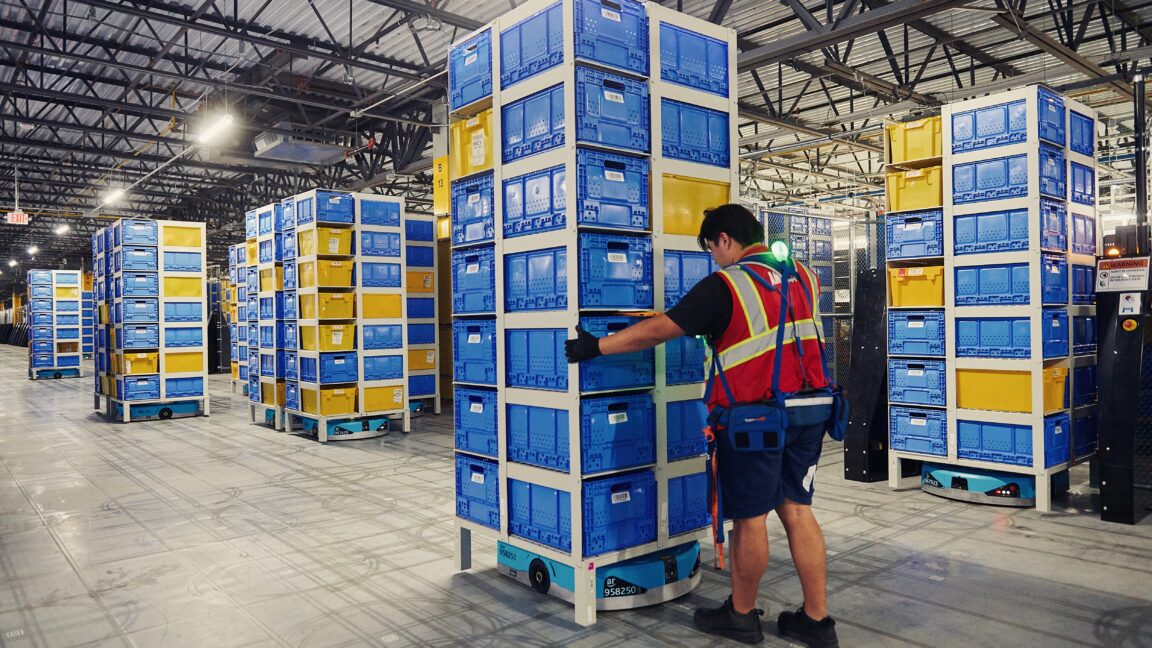
Amazon operates more than 1 million robots in its warehouses around the clock, supporting tens of millions of same-day and one-day deliveries daily, and the company says it will significantly grow that fleet in coming years through new factories building increasingly capable machines. It is simultaneously the second-largest corporate employer in the world, with more than 1.5 million full-time and part-time workers according to its 2025 annual report.
Amazon traces its robotics program to the 2012 acquisition of Kiva Systems, which pioneered wheeled mobile robots that carry racks of inventory to workers rather than making people walk the floor. Kiva was renamed Amazon Robotics, which now mainly manufactures robots in-house in Massachusetts. This year Amazon announced additional production sites in Austin, Texas, and Greenwood, Indiana.
Most of the fleet remains wheeled mobile robots. Amazon says its Sequoia system can identify and store items up to 75 percent faster by coordinating swarms of these machines. Hercules and Titan units, described as roughly the size of a pool table and a baby grand piano respectively, move tall fabric shelving pods packed with plastic totes to human workstations. These robots generally follow grid lines of floor stickers inside fenced areas, but the newer Proteus model carries sensors that let it roam more freely around people. Because swarms moving through narrow aisles can create traffic jams, Amazon coordinates them with a suite of AI foundation models called DeepFleet that predict congestion.
Robotic arms are the faster-growing category. Amazon CFO Brian Olsavsky said on a July earnings call that the company expects to more than double its existing arm fleet this year; Scott Dresser, vice president of Amazon Robotics, characterized the current deployed count as being in the single-digit thousands. Amazon first bought third-party arms for lifting and stacking pallets and bins, then developed Robin in-house for sorting individual mailers and boxes from cluttered piles. Robin was tested in 2021 and debuted at a Lakeland, Florida, facility in 2022.
Robin uses eight suction cups to pick up packages, and its software analyzes a top-down view of a cluttered conveyor belt and ranks possible picking actions before moving. In a 2023 paper, the Amazon Robotics team described replacing hand-crafted picking strategies with machine learning. The model initially trained on more than 394,000 picking actions from deployed arms to estimate success probabilities, then used an online pick ranker to prioritize actions. In that trial the best machine-learning method reached a 93.73 percent success rate versus 92.28 percent for the best traditional algorithm. The gap sounds small but translated to roughly 16,500 fewer failed picks during a period involving more than 1 million total picks. The team later reported a 20 percent reduction in failed pick rate in an experiment involving 2 million picks at robotic workstations configured to resemble the Robin fleet, presented at the International Symposium on Experimental Robotics in July 2025.
Cardinal followed, placing packages weighing up to 50 pounds into wheeled carts bound for trucks. It began operating at a Nashville, Tennessee, facility in November 2022. Dresser likened the dense packing problem to Tetris, noting that dense containers help both sustainability and transportation cost. Amazon has just begun deploying Cardinal in larger numbers and expects to continue over the next several years.
Sparrow targets a harder problem: handling the hundreds of millions of products of varying shapes and sizes that flow into customer orders. It consolidates items from partially filled container-size totes to build densely packed ones, continually refilling totes as orders are fulfilled. Dresser said Sparrow was the first place Amazon truly deployed foundation models in physical robotics to cope with that product diversity, removing the need to hand-code every item. The team has since built a perception foundation model intended to handle never-before-seen products and a generalized action model compatible with different arm types using varying combinations of suction and finger grasping. Kapil Katyal, a senior applied science manager at Amazon Robotics, said at a September 29 presentation at the Intelligent Robots & Systems conference in Pittsburgh that building ad hoc perception models for every task and robot embodiment does not scale.
Vulcan is Amazon's newest arm and the first to combine vision with force-feedback sensors that provide a sense of touch, letting it pick and stow items inside fabric-covered inventory pods. Dresser said inserting an item, creating space, or pulling something out are hard for non-touch systems such as Sparrow's suction approach. Vulcan began operating at fulfillment centers in Spokane, Washington, and Hamburg, Germany, in 2025. It is not widely deployed yet, but Dresser said Amazon expects to scale it up in 2027.
Amazon executives say the fleet has eased the burden on human workers by absorbing the toughest tasks with the greatest risk of fatigue and injury. The company points to improved safety figures overall: a spokesperson said that since 2019 Amazon's Global Recordable Incident Rate improved 43 percent and its Global Lost Time Incident rate, covering the most serious injuries requiring time away from work, improved 70 percent, and that these gains came alongside robotics growth.
Critics dispute the rosy framing. The Strategic Organizing Center, a Washington, DC-based coalition of trade unions, published reports in May 2021 and April 2022 finding higher injury rates at Amazon's robotic warehouses than at non-robotic ones, drawing on company-reported injury data from 2017 through 2020. Joan Moriarty, the group's director of strategic research and campaigns, said Amazon prefers discussing its newest robots over the tens of thousands of workers injured annually, and cited an online survey of nearly 1,000 Amazon workers conducted in February 2021 in which respondents said robots raise the expected pace of work. A 2024 Senate HELP Committee investigation led by Sen. Bernie Sanders (I-Vt) noted that Amazon's internal data also suggested a link between robotic productivity and increased pressure on workers. Amazon has called these reports flawed and reliant on older data predating its modern robots.
The most nuanced evidence comes from an April 2025 study in the journal ILR Review. It found robotic warehouses had a 40 percent decrease in severe injuries compared with legacy fulfillment centers, but a 77 percent increase in less severe injuries associated with repetitive-motion strain. Coauthor Brad Greenwood, a business professor at George Mason University, attributed that pattern at least partly to pace, noting that pick rates at robotic fulfillment centers are far higher. A robot dictating the pace, he said, appears to drive strains and sprains. The study used Amazon company data obtained by journalists at Reveal and the Center for Investigative Reporting, covering weekly records at more than 150 warehouses from 2016 through 2019, and also analyzed Reddit comments in which employees described robotic-center work as less physically stressful but mentally exhausting. Greenwood said the dynamics still look relevant, pointing to continuing high turnover across warehousing. He also drew a distinction between historic automation, which typically removed high-risk tasks at a distance from workers, and collaborative robots that are physically proximate and can set the pace of work.
On employment, Amazon frames robotics as creating new roles. It says fulfillment centers with advanced robotics typically require 30 percent more employees in reliability, maintenance and engineering, and that each new robot-manufacturing facility will bring more than 300 jobs. The article does not provide a net employment figure for automation overall.
Why it matters: Developers and product teams building robotics, warehouse software or human-in-the-loop systems should note that the hard technical problems here are perception and manipulation generalization, not raw mechanical capability, and that foundation models are already being used to avoid per-item and per-embodiment engineering. The safety data is the more consequential signal for anyone designing collaborative automation: measured across studies, robots appear to cut severe injuries while raising repetitive-strain injuries, probably because they set the work pace, so throughput metrics cannot be treated as a proxy for worker outcomes. It is a reasonable inference, not a stated fact, that regulators and unions will press for pace and injury reporting alongside deployment claims as Amazon scales Vulcan and doubles its arm fleet.
Based on reporting from the original publisher. Visit the source for full context and later updates.
Publisher excerpt
The second-largest corporate employer has bet big on robot workers to scale.