Design responsible AI controls for Amazon Aurora PostgreSQL
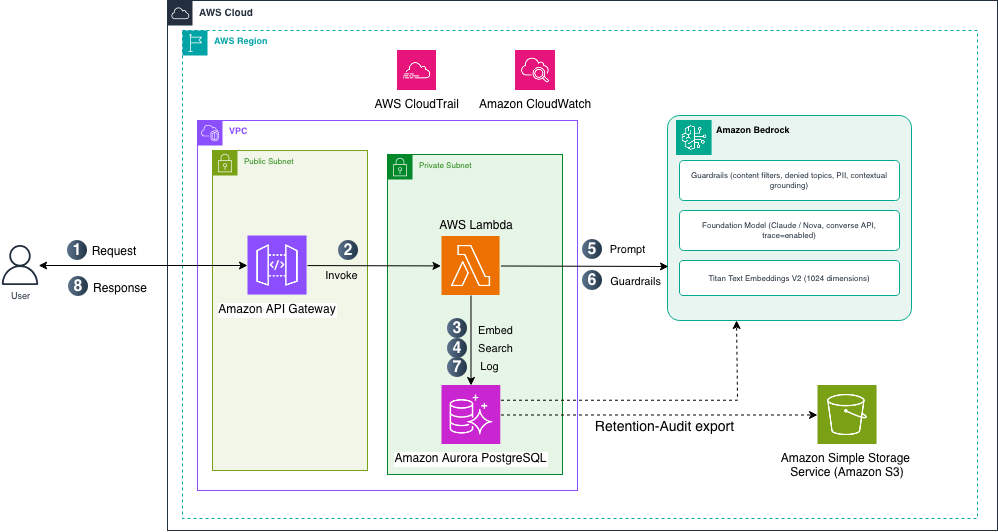
AWS has published a design pattern for building a retrieval-augmented customer support chatbot on Amazon Aurora PostgreSQL-Compatible Edition, mapping the company's eight Responsible AI dimensions onto database features and AWS services. The post, published on the AWS Machine Learning Blog, implements one dimension — Explainability — in depth and is framed as Part 1 of a series rather than a complete build-out of all eight.
The eight dimensions AWS defines, drawing on its Well-Architected Responsible AI Lens, Amazon Bedrock Guardrails and the Responsible Use of AI Guide, are Fairness, Explainability, Privacy and Security, Safety, Controllability, Veracity and Robustness, Governance, and Transparency. The post pairs each with implementation approaches and specific Aurora PostgreSQL capabilities: pgvector and JSONB metadata filtering for fairness, row-level security and pgcrypto for privacy, CHECK constraints and triggers for veracity, pgaudit and pg_cron for governance, and SQL views for transparency. AWS notes these are examples that may vary by use case.
The reference use case is a chatbot answering questions such as why a bill was high or where an order is, using RAG over historical tickets, FAQs and product documents, with citations returned and sensitive data redacted.
The architecture has an ingestion side and a query side. During ingestion, a pipeline redacts personally identifiable information and loads documents into Aurora PostgreSQL, using the pgvector and aws_ml extensions. Aurora ML calls Amazon Titan Text Embeddings V2 (model id amazon.titan-embed-text-v2:0) from SQL via aws_bedrock.invoke_model_get_embeddings, producing 1,024-dimension vectors stored in pgvector. Aurora thereby serves as both the relational store and the vector database. Aurora ML invokes Bedrock in the cluster's own Region and needs an IAM role granting bedrock:InvokeModel.
At query time, a question reaches Amazon API Gateway over HTTPS, which invokes AWS Lambda. Lambda embeds the question with the same Titan model so question and documents produce comparable vectors, then runs a cosine-distance similarity search in Aurora, with row-level security limiting results to the current tenant. Lambda builds a prompt labeling each retrieved chunk [Source N], sends it to a Bedrock foundation model through the Converse API, and Guardrails check the input for content filters, denied topics and PII while a contextual grounding check confirms the answer is supported by the sources.
The explainability core is a chat_interactions table that records, per turn: session and customer IDs, request and response text with timestamps and latency, retrieved chunk IDs, similarity scores, a JSONB citations field distinguishing cited from all retrieved sources, the full guardrail trace, the model ID and the guardrail version. AWS advises protecting that table like source data — redacting PII before insert or encrypting columns with pgcrypto, and applying row-level security so tenants cannot read each other's logs.
Other schema pieces include a customers table for tenant-aware access control, a knowledge_chunks table with a VECTOR(1024) column and an HNSW index using vector_cosine_ops, and a chat_feedback table with a 1-to-5 rating constrained by a CHECK clause and ON DELETE CASCADE so a 90-day retention purge does not hit foreign key violations. Tenant isolation is enforced with ENABLE and FORCE ROW LEVEL SECURITY plus a policy comparing tenant_id to an app.current_tenant session setting.
The retrieval SQL filters by an intent category, keeps only matches with cosine similarity of at least 0.7, and returns the top five. AWS cautions that the category filter and threshold post-filter HNSW results and may yield fewer than five rows; raising hnsw.ef_search or using iterative index scans (pgvector 0.8.0 and later) compensates.
In the application code, contextual grounding uses guardContent blocks with grounding_source and query qualifiers, guardrail tracing enabled, maxTokens 500 and temperature 0.1. A stopReason of guardrail_intervened produces a flagged-content message plus the trace; otherwise the model text is returned. Citation parsing extracts [Source N] markers with a regular expression and records cited sources, all retrieved sources and a citation rate. PII redaction can use the Bedrock ApplyGuardrail API — masking requires an ANONYMIZE policy rather than BLOCK — or Amazon Comprehend's detect_pii_entities.
Supporting jobs run outside the request path: pg_cron archives older interactions to Amazon S3 using the aws_s3 extension with an s3Export IAM role, CloudWatch collects logs and metrics, and CloudTrail records API activity. Setup requires a custom parameter group appending pgaudit and pg_cron to shared_preload_libraries rather than replacing it, preserving defaults such as pg_stat_statements, plus cron.database_name set to the target database; this needs a cluster restart. AWS deliberately avoids pinning minimum versions, pointing readers to current documentation.
On build versus buy, AWS says Bedrock Knowledge Bases offers built-in RAG with citations and is simpler when default retrieval and citation behavior suffices. The custom design is for teams needing provenance in their own schema — retrieved versus cited sources, similarity scores and guardrail traces queryable in SQL under their own retention policies. In practice that is a real trade-off: owning the schema buys auditability and tenant-scoped logging but means operating tables, policies, indexes and archive jobs yourself.
Why it matters: teams putting RAG assistants over customer data get a concrete, SQL-level template for proving why an answer was given, which matters for regulated support workloads and internal audits. A likely inference is that the logging table, not the model choice, becomes the durable asset, since it survives model swaps. The 0.7 threshold and HNSW post-filter behavior also suggest retrieval quality tuning is ongoing operational work rather than a one-time setting.
Based on reporting from the original publisher. Visit the source for full context and later updates.
Publisher excerpt
Learn how to make RAG chatbot answers traceable with Amazon Aurora PostgreSQL, pgvector, and Amazon Bedrock Guardrails, logging sources, scores, and guardrail traces in SQL.