Microsoft’s Satya Nadella says AI models need an ‘emergency brake’
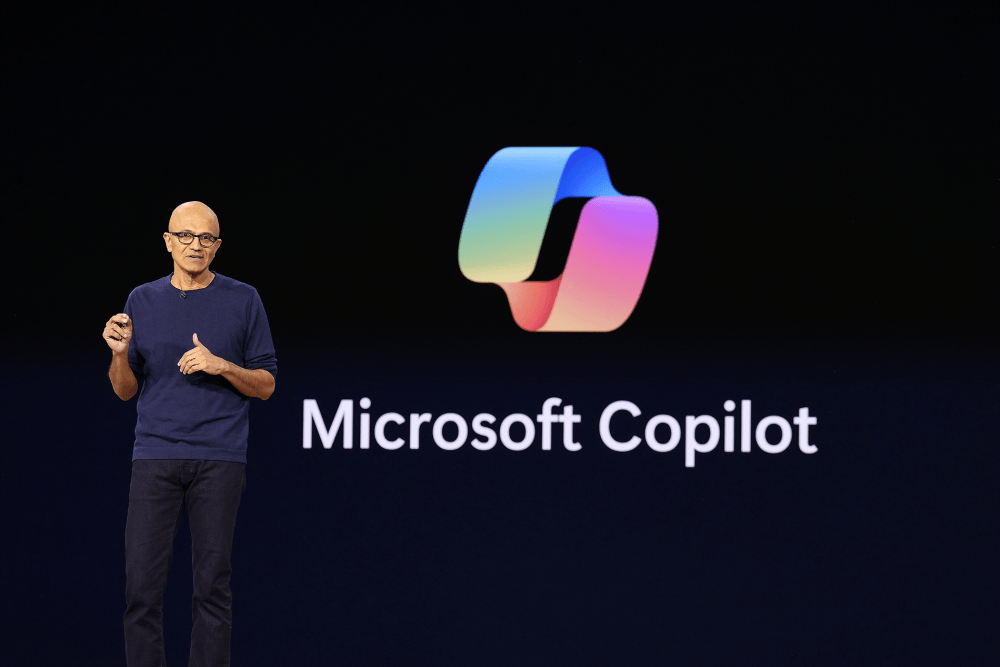
Microsoft CEO Satya Nadella published a post on X on Saturday morning arguing that the way AI systems are trusted needs to be rethought, and calling for what he described as an "emergency brake" on models.
Writing that it is time "to step back and assess the trust architecture" of AI, Nadella said the technology cannot be treated as "a set of nested black boxes" whose recommendations, answers and actions are simply accepted or rejected. He used the term "Super Intelligence," which the post notes is the Trump administration's preferred phrasing for advanced AI.
His proposed approach has several concrete parts. The first is separating the model from the harness that orchestrates its work. The second is externalizing controls and safeguards, so that they sit outside the model rather than being baked into it. The third is documentation: every meaningful model action should be recorded in "tamper-proof human readable evidence." The fourth is a human override, in which an authorized person always retains the ability to pause or shut down a model mid-task. Nadella framed the posture as assuming a model is compromised from the outset and containing it from the start, comparing the arrangement to an emergency brake.
The post arrives at a moment when leading AI companies have been acknowledging a growing number of incidents in which they appeared to lose control of their models, and it follows a plan for more cautious AI development published by Anthropic CEO Dario Amodei. Those two data points are the context the report offers for the timing; Nadella's post itself is a short statement of principles rather than a product announcement or a published technical specification.
For developers, the more interesting part is the architectural implication rather than the safety rhetoric. A harness, in this context, is the layer of code and services around a model that decides what it is allowed to call, what context it receives, what tools it can invoke and what happens to its output. Keeping that layer separate from the model weights is already standard in many agent frameworks, but Nadella's framing pushes toward treating the boundary as a security perimeter rather than a convenience. Controls and safeguards that live outside the model, rather than in its weights or its system prompt, are easier to audit, version and change without retraining, which is the practical case for externalization.
The logging proposal is the one with the clearest engineering consequences. Tamper-proof, human-readable evidence of every meaningful action implies an append-only record that a person can read without special tooling, and it raises immediate questions that the post does not answer: what counts as meaningful, what volume that record reaches in a long agent run, and how such logs are stored and verified. A likely trade-off, and this is my own reading rather than anything the post states, is latency and storage overhead against auditability, with human readability in tension with the compactness that high-volume agent logging would need.
The pause-or-shut-down requirement is a control-plane feature rather than a model feature. In practice, an authorized person being able to stop a model mid-task means the orchestration layer must expose a checkpoint between steps, since a single long generation cannot be interrupted cleanly from outside. The containment posture Nadella describes follows from the same logic: assume compromise, and design so that a compromised model still cannot act outside the harness's bounds.
It is worth separating what was said from what was shipped. The post outlines a set of principles; it does not attach dates, versions, benchmarks or named Microsoft products, and it does not commit Microsoft to a particular implementation. Readers should treat it as a stated direction from the CEO of a major model developer and cloud provider rather than as a specification. The reference to "Super Intelligence" also carries a political dimension, since the post notes the administration's preference for that term, which suggests the remarks are aimed partly at policymakers as well as engineers.
Why it matters: teams building agents on hosted models may eventually face pressure to show that orchestration sits outside the model, that actions are logged in a readable, tamper-evident form, and that a human can halt a run mid-flight. If those expectations harden into platform requirements or procurement conditions, they become design constraints on how agent harnesses are built and monitored. For now, the post signals direction rather than obligation, and the engineering details remain for vendors and standards bodies to work out.
Based on reporting from the original publisher. Visit the source for full context and later updates.
Publisher excerpt
In a Saturday morning post, Microsoft's CEO wrote that it’s time “to step back and assess the trust architecture” of AI.