Production AI and Engineering Team Design: InfoQ’s November Certification Cohorts
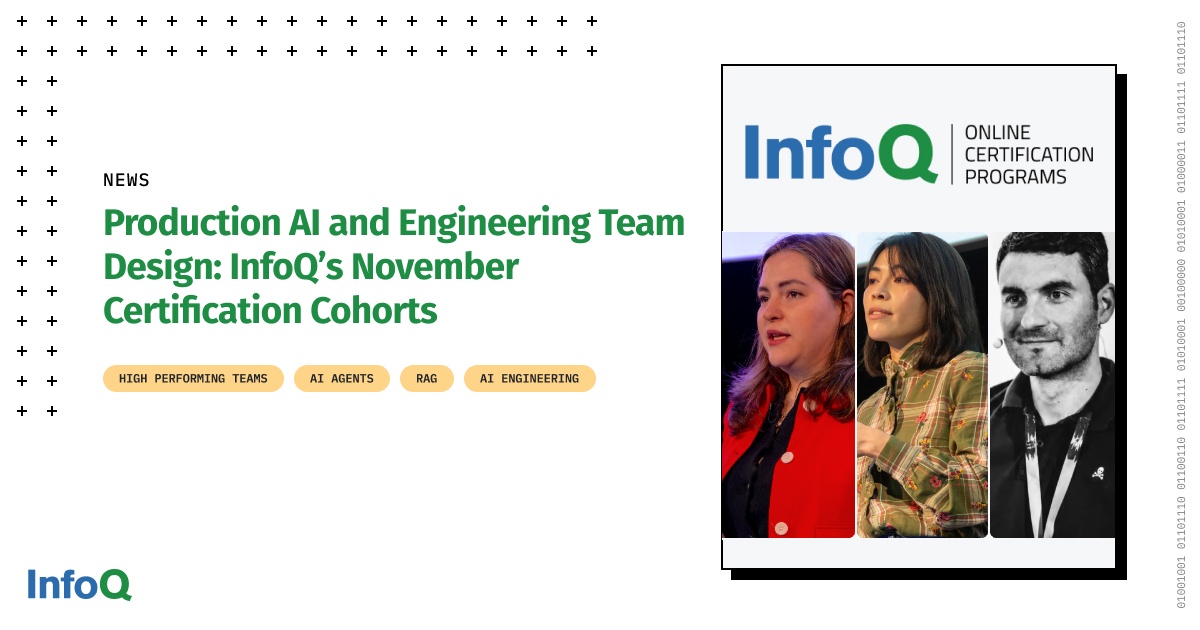
InfoQ has published details of three online certification cohorts beginning in November 2026. Two cover AI engineering — one facilitated by Adi Polak starting November 12 in the PST timezone, another by Lan Chu starting November 13 in the CET timezone — and a third, on High-Performing Teams, is facilitated by Olimpiu Pop and starts November 17. Details appear in a preview by Artenisa Chatziou. Each cohort follows its facilitator's own published syllabus rather than a shared set of exercises, so the two AI tracks diverge in emphasis even though both address production systems.
The AI Engineering program treats AI applications as more than a model choice. Its stated scope covers retrieval-augmented generation (RAG), context and memory pipelines, agent design, AI infrastructure, evaluations and reliability. The framing problem is that retrieval can surface stale or incomplete context, more autonomous agents force decisions about control and verification, and shared inference infrastructure raises questions of ownership and cost.
Polak, author of Scaling Machine Learning with Spark and an engineering leader who has built machine learning and real-time streaming pipelines, leads the November 12 cohort. Her syllabus draws on QCon material about context engineering, comparing vector retrieval with Graph RAG and examining how agents share state and context. Later weeks move into orchestration, control, inference gateways and rollout-readiness evaluations.
Chu is a principal engineer with more than seven years building production data and machine learning systems, and leads the November 13 cohort. Her syllabus builds on her QCon London case study of a RAG system running on more than 10,000 documents and used by more than 300 people. Participants trace retrieval and indexing decisions, compare vector retrieval with Graph RAG, weigh single-agent against multi-agent designs, and pick production-readiness checks.
The Graph RAG versus vector retrieval comparison running through both syllabuses reflects a live architectural trade-off. Plain vector search embeds chunks and retrieves by similarity, which is cheap and simple but weak at multi-hop questions where the answer depends on relationships across documents. Graph-based approaches add an explicit structure of entities and links, improving relational queries at the cost of building and maintaining that graph. This suggests the courses are aimed at teams already past a first prototype and now hitting accuracy or maintenance ceilings.
The High-Performing Teams program starts from a different premise: faster code production does not necessarily shorten delivery time. Review, approvals, infrastructure dependencies or rework can become the binding constraint. Adding AI agents also shifts who prepares context, who reviews output and who stays accountable for decisions. The cohort treats these as parts of a single operating model.
Pop, an InfoQ Podcast co-host with 20 years across software architecture, engineering management and technology leadership, facilitates the November 17 cohort. Participants examine team boundaries and delivery flow, map dependencies, consider which tasks to delegate to AI alongside human judgment, and assess whether familiar output metrics remain informative. The group capstone is to develop and present a target operating model tying together responsibilities, delivery flow, AI roles and measurement.
The format is deliberately peer-heavy: senior engineers and architects from other companies apply QCon talk material to decisions they currently face. Sessions are live and not recorded. The workload is four live hours per week plus up to two hours of independent work. Certification requires participation and successful completion of the relevant capstone, and selected work may be considered for InfoQ publication — though the source is explicit that publication is not automatic.
For developers and product teams, the practical question is fit. The AI tracks assume hands-on involvement with retrieval, agents or inference infrastructure; the teams track assumes responsibility for delivery flow or engineering management. The unrecorded, live format also means the material does not become an on-demand resource afterward, which matters for anyone weighing cost against schedule flexibility. Full dates, per-facilitator syllabuses and participation details are on the InfoQ Online Certification Programs site.
Why it matters: Teams building RAG and agent systems face concrete choices — vector versus graph retrieval, single versus multi-agent design, where to put inference gateways and how to evaluate rollout readiness — that these cohorts address directly. The teams track points at a second-order effect: if AI speeds up coding without shortening delivery, the bottleneck moves to review and dependencies, and leaders need new measures. Developers and product managers deciding where to invest training time in November should treat the two AI tracks as complementary rather than interchangeable, given their separate syllabuses.
Based on reporting from the original publisher. Visit the source for full context and later updates.
Publisher excerpt
A preview of three November InfoQ online certification cohorts covering production AI systems, retrieval and agent design, engineering team flow, AI roles, and measurement, facilitated by Adi Polak, Lan Chu, and Olimpiu Pop. By Artenisa Chatziou