Supersonic airliner in doubt as company shifts to powering AI data centers
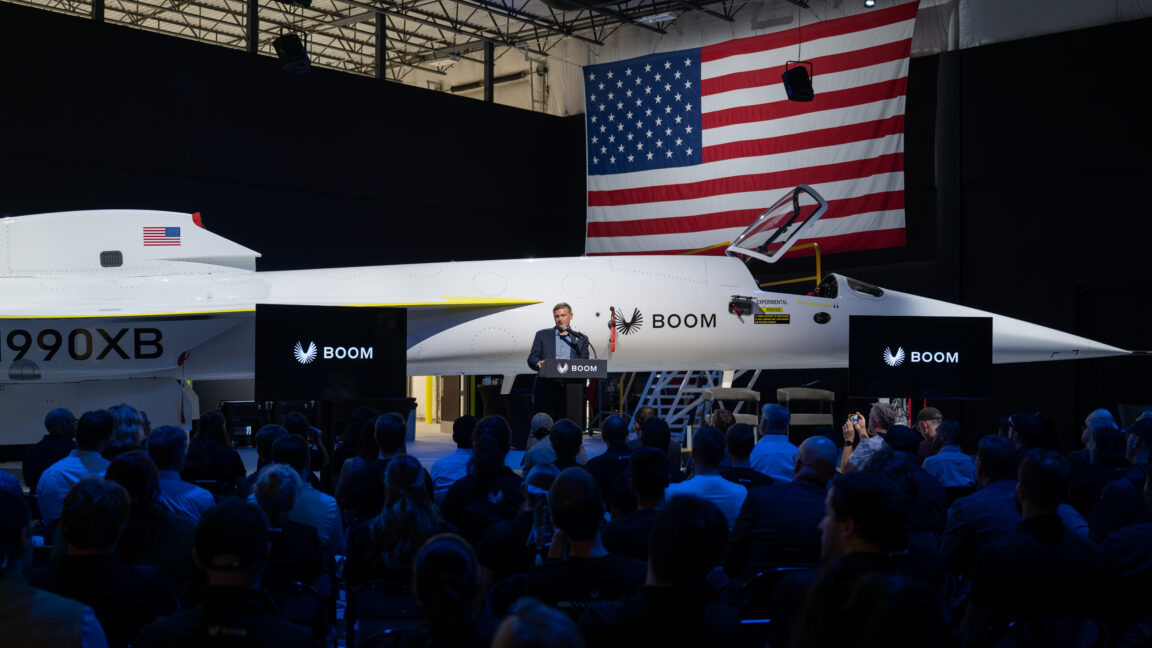
Boom Supersonic has split its attention between two very different products. On October 22 the company unveiled a factory in Centennial, Colorado, dedicated to producing a 42-megawatt natural gas turbine called Superpower for AI data centers, with US Secretary of Energy Chris Wright and Colorado Governor Jared Polis attending. Days later, on October 28, United Airlines CEO Scott Kirby said on the Office Hours: Business Edition podcast that Boom's official 2029 timeline for delivering the first Overture supersonic airliner will not hold. "It's not going to happen in '29—it's going to take longer," Kirby told host Monica Langley, while praising CEO Blake Scholl and the company generally and cautioning that Boom still has many hurdles to clear, including FAA certification.
Kirby is not a disinterested observer. United is one of Boom's early customers, holding a conditional agreement alongside American Airlines and Japan Airlines. Those deals involve non-refundable deposits of undisclosed size and would let the carriers buy Overture aircraft once it is commercially available. Kirby had already put the odds of Overture entering commercial service at "50-50" in March. Boom's public statements have described certification and carrying paying passengers by 2029.
The Overture program has visible gaps between announcements and activity. Boom finished its Overture production factory at Piedmont Triad International Airport in Greensboro, North Carolina, in 2024, but the site has largely sat idle since, a point of friction for North Carolina officials who put more than $50 million in taxpayer money into the build. On the regulatory side, the FAA in June 2026 proposed overturning the long-standing ban on commercial supersonic flights over the United States, following an executive order from President Donald Trump. The company's demonstration work has centered on the XB-1, which flew in 2024 and 2025 to test a "boomless cruise" concept built around the Mach cutoff phenomenon.
That phenomenon is worth explaining, since it underpins Boom's quieter-flight pitch. At certain altitudes and atmospheric conditions, an aircraft flying slightly above the speed of sound can have its shockwaves refract upward rather than reaching the ground, muting the boom. It is a real physical effect, but it depends on weather and flight profile, which makes it harder to guarantee on every route. NASA has been flying the X-59, with its long needle nose, since October 2025 on a different approach to softening sonic booms. The two efforts are not the same technique.
The data center turbine is the newer story, and the more concrete one commercially. Boom says the Colorado plant is already making parts while construction finishes. It aims to ship the first turbines to AI data center customers in mid-2027, reach 25 turbines a year in 2028 and 50 a year by 2029. At 42 megawatts each, 50 units a year would represent roughly 2.1 gigawatts of annual manufacturing capacity, which gives a sense of the scale Boom is targeting.
Demand for on-site gas power is real. Tech companies building AI campuses have been racing to secure electricity faster than grids can deliver it, and some developers have resorted to mobile gas generators on trucks or aeroderivative turbines adapted from aircraft and warships, according to the market intelligence platform Cleanview. Boom is positioning its turbine as a purpose-built answer to that squeeze.
There has been a setback. Scholl acknowledged on X on September 25 that Boom lost a $1.25 billion deal in which data center developer Crusoe would have bought 29 of its turbines. Crusoe has built Texas data centers for Oracle, Google and Microsoft. Scholl said Boom will nonetheless deliver about 250 megawatts of Superpower units to other sites next year, without naming the customers. That figure is roughly six turbines at the stated rating, well short of the lost order.
The strategic logic Boom is selling is shared engineering. The company says it has completed a prototype turbine core called Sprint Core, intended to eventually power both the Superpower gas turbine and the Symphony engine planned for Overture. The core is to be tested at the Colorado Air & Space Port, with a first firing planned before Thanksgiving. That is a tangible milestone, though a first firing is an early step; a flight-qualified engine for a supersonic airliner is a far longer road, and the two applications impose different requirements on durability, weight and certification.
My reading is that the two businesses are less synergistic than the messaging suggests, at least on the timeline that matters. A stationary gas turbine can tolerate weight and bulk that an airliner engine cannot, and data center customers care about delivery dates and uptime rather than FAA airworthiness. Sharing a core design may save some development cost, but it does not obviously shorten the certification path for Overture. The company's own production targets point the same way: turbines shipping in 2027 versus an airliner that its launch customer now expects after 2029.
The financial picture is a likely reason for the pivot. Building a supersonic airliner requires years of capital before any revenue, while data center turbines can be sold to customers with urgent power needs. Whether turbine revenue can fund the airliner, or whether it competes for the same engineering attention, is the central question Boom faces. The lost Crusoe order also shows the turbine business is not assured; competition from established turbine makers and adapted aero engines is significant.
Why it matters: Airlines holding conditional Overture orders, including United, American and Japan Airlines, now face a delivery schedule their own executives doubt, which affects fleet planning and how much weight those non-refundable deposits carry. For developers and infrastructure teams, Boom is joining a crowded field of fast-to-deploy gas power for AI campuses, and its mid-2027 target would make it a real option only if the Sprint Core test program stays on track—an inference, since a first engine firing is a long way from volume deliveries. The FAA's proposed rule change, if finalized, would remove a legal barrier to US overland supersonic flight, but certification of the aircraft itself remains the harder constraint.
Based on reporting from the original publisher. Visit the source for full context and later updates.
Publisher excerpt
Boom’s airliner may be delayed, and its data center power business lost a customer.