From learning to leaderboard: How Cisco upskilled 1,200 engineers in agentic AI with AWS AI League
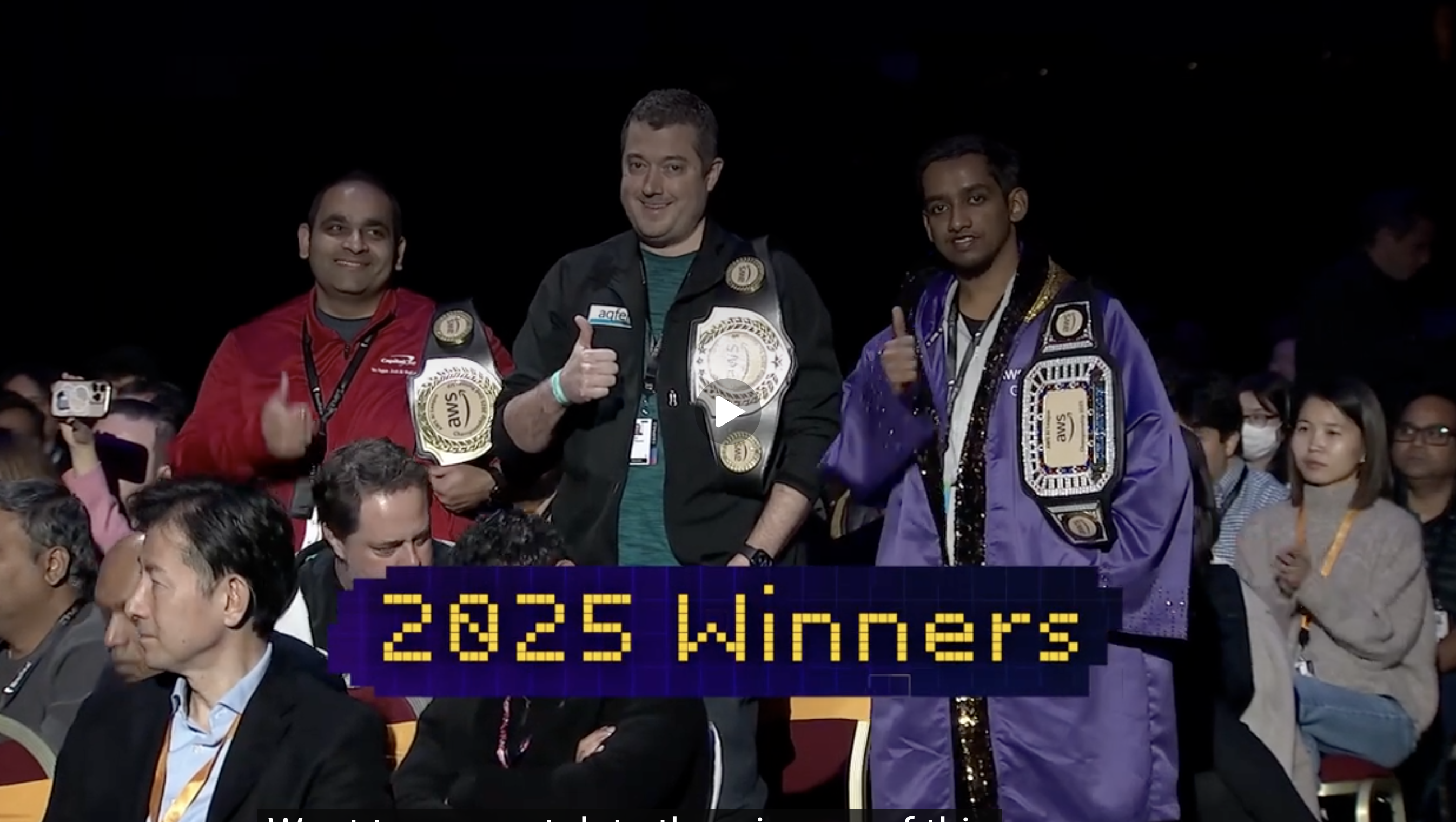
Cisco ran a full AWS AI League agentic AI tournament at its Transformation Fest 4.0 in 2026, drawing 1,200 Cisco engineers into a competition to build agents on Amazon Bedrock AgentCore. Nishanth Aluhonnu, a Cisco software engineer, finished first at each stage — qualifier, semifinal and the live three-round finale — and won a full conference pass to AWS re:Invent 2026 in Las Vegas. The tournament follows a 2025 run in which Hemanth V, a software engineer on Cisco's switching core platform team, won a model customization challenge at Transformation Fest 3.0 against more than 600 colleagues and then took the first AWS AI League global title at re:Invent 2025, finishing ahead of Ross Williams of Aqfer (second) and Deepesh Khanna of Capital One (third).
Transformation Fest started in 2022 as a single event and is now a three-day annual program that has completed four editions and reached around 2,000 engineers. Its formats include AWS GameDays, AWS AI League, peer sessions where Cisco leaders share practices, and sessions on Amazon and AWS culture. The team organizes the program around five tenets it calls SCALE: share what you know with peers, connect with engineers across business units, adopt new skills and AWS services, learn by building rather than watching, and experiment hands-on while staying engaged. The AWS account team ran pre-event training so engineers without prior agentic AI experience could compete from day one.
AWS AI League itself is structured in three stages: a two-hour hands-on workshop led by AWS experts, a self-paced build phase with submissions judged by an automated evaluator and reflected on a live leaderboard, and a game-show-style finale for top finalists. At Cisco it offered two tracks. The agentic AI challenge has agents navigate a maze-like grid toward a treasure chest while handling tasks that mirror real work — filtering inappropriate content, running code, retrieving web information, extracting structured data. Builders pick models for supervisor and sub-agents and can attach tools such as AgentCore memory and AWS Lambda event functions, with Amazon Bedrock Guardrails for safety controls. The model customization challenge has participants fine-tune models in Amazon SageMaker Studio, with points awarded when an evaluator rates their model as more accurate and comprehensive than a reference model. Finalists are scored on time efficiency, accuracy, agent planning and token consumption efficiency.
In the 2026 qualifier, the top five from each of four cohorts advanced to a 20-person semifinal, from which three finalists reached the stage. Aluhonnu's route ran through first place in cohort 3 with 15,906 points across 98 submissions, then 16,321 points in the semifinal, and 27,008 cumulative points in the finale. During the finale, participants could not change code, tools or prompts — only issue a short steering instruction before each round — so results depended on how well each agent handled maps it had never seen. Aluhonnu lost the first round and then won the second by a wide margin by skipping a board full of low-value coins in favor of a single high-value challenge.
AWS's write-up draws out three design lessons from the winning agent that map onto production decisions. The first is that output tokens dominate cost. Token bonus is computed as 1000 minus total output tokens divided by challenges visited, and in the qualifier the top four agents all solved the map: the winner emitted 1,220 output tokens against 1,430 for second place, a final margin of only 16 points out of nearly 16,000. By testing nine single-variable variants of the agent, Aluhonnu's team found that tool results and the system prompt were not scored, but everything the agent wrote — including tool-call arguments — was, with roughly 52 tokens of fixed overhead per tool call on top of its arguments. In practice that matches how inference is billed: output generation is sequential and typically priced several times higher than input, and the cost compounds across every step of an agent loop. A long, cacheable system prompt is cheap; a chatty agent is not. That is a reasonable reading of the economics even outside a competition — teams running agents at volume usually find verbose tool-call behavior is where spend leaks.
The second lesson concerns architecture. The reference design for the challenge is a supervisor agent on AgentCore runtime coordinating three sub-agents (navigation, computation, web retrieval) through the AgentCore Gateway to tools including a browser, a code executor and Lambda-backed custom functions. The winning design used one agent with no sub-agents, opening its prompt with a short dispatch table that matched each challenge type to an approach in a single turn. The rationale: every handoff is a message the model must write, and written tokens were scored. This is not an argument that sub-agents are bad; it is a reminder to weigh what coordination costs. Where token budget or latency is tight, flatter designs can win; where work genuinely decomposes into specialist domains, the supervisor pattern still earns its overhead.
The third lesson is to keep deterministic work out of the model. Route planning ran in an AWS Lambda function that treated the board as an optimization problem, assigning each tile an expected value of points paid minus lives risked minus tokens likely spent, respecting constraints such as collecting a key before passing its door, and refining within a time budget. The second finale round was built as a trap: a seven-by-seven board mostly covered in 25-point coins with one scheduling tile worth 1,500 points. The value table identified the coins as noise, and the agent scored 7,537 points in that round against 5,953 for the next finalist — the lead that carried it to the overall win. The generalizable pattern is to let the model handle language and judgment while search, arithmetic and rule enforcement live in tools that are faster, cheaper and repeatable.
The Cisco and AWS relationship behind the program spans several shared products, including Cisco SD-WAN, whose controller architecture runs on AWS as a SaaS application, plus Meraki, Cisco Spaces, the IoT and smart buildings group, Cisco Cloud Control, and Cisco AI Defense, where Cisco's security team uses Amazon Bedrock and SageMaker AI for AI governance and guardrails. Kumaril Kapoor, Cisco's VP of Engineering, described business units independently choosing to build next-generation platforms natively on AWS as an engineering partnership rather than a vendor relationship.
Why it matters: For organizations trying to move engineers from watching AI demos to shipping agents, this is a concrete, scaled playbook — pre-event training, an automated evaluator with a live leaderboard, and a public finale — and it reportedly brought 1,200 engineers through hands-on agent work, many without prior experience. For developers, the technical takeaways are immediately usable: treat output tokens, including tool-call arguments, as the primary cost lever; question multi-agent handoffs when coordination is expensive; and push deterministic planning into code. The inference that follows is that gamified, scored formats may surface efficiency discipline faster than conventional training, because the leaderboard makes token spend visible in a way production dashboards often do not.
Based on reporting from the original publisher. Visit the source for full context and later updates.
Publisher excerpt
Cisco and AWS used Cisco Transformation Fest and AWS AI League to turn hands-on AI learning into a culture of building. A Cisco engineer won the 2025 AWS AI League global title and 1,200 engineers competed in 2026. This post shares Cisco's journey, lessons from the 2026 winning agent built on Amazon Bedrock AgentCore, and how to host your own league.