Can Frontier Models See Past a Decoy? Elorian Tests Visual Reasoning
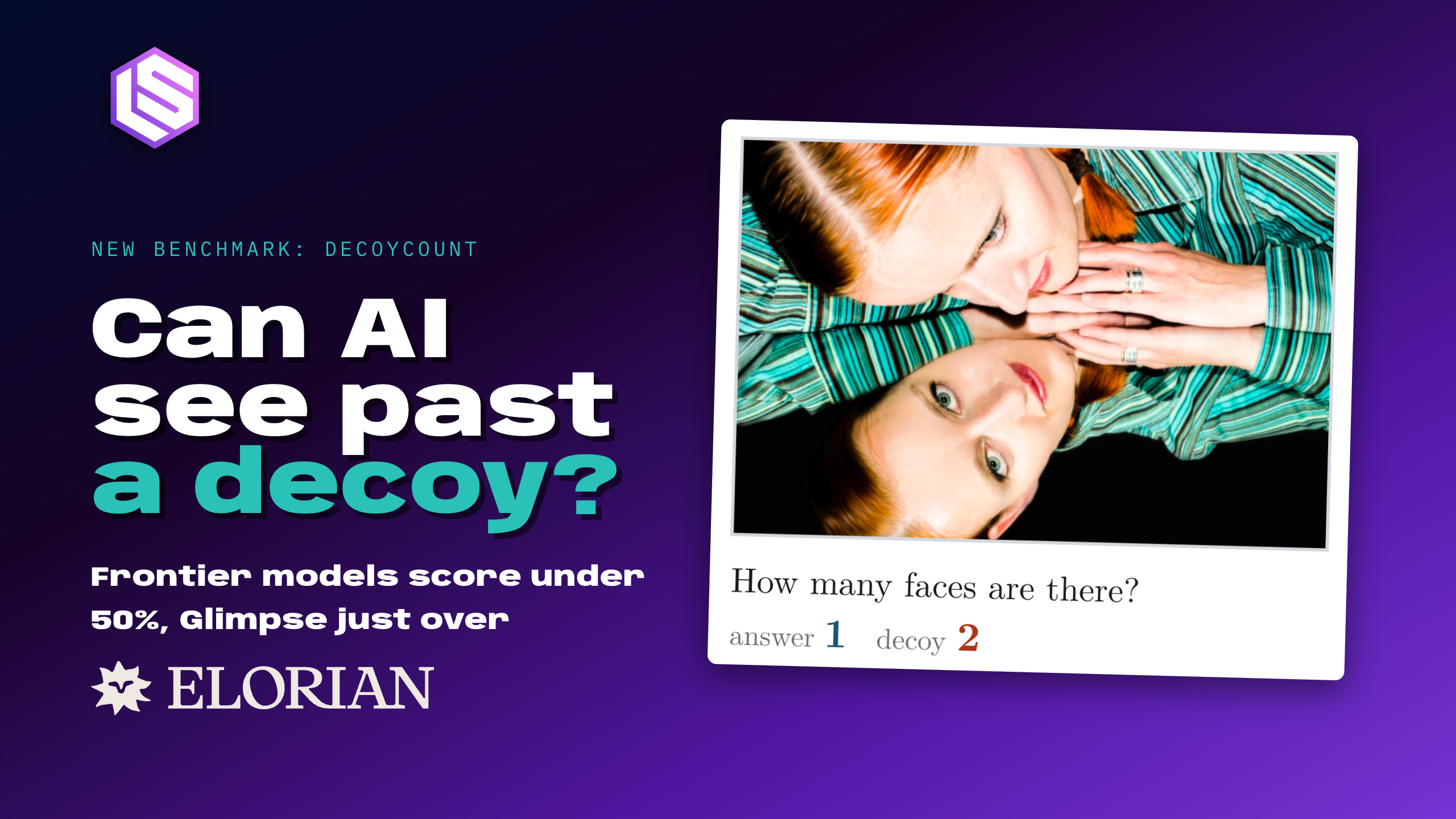
Elorian, a startup that came out of stealth in April with $55 million in seed funding co-led by Striker Venture Partners, Menlo Ventures and Altimeter Capital, has launched its first visual reasoning model, Glimpse, and co-released a benchmark called DecoyCount with AI data company Mercor. The benchmark asks whether language models actually count objects in an image or lean on visual shortcuts and substitution heuristics. A paper accompanying the release reports that frontier models all landed under 50% accuracy, with GPT-6 Astra the best at 43.17%. Glimpse does not appear in that paper, but CEO Andrew Dai said in an email that it hit 50.48% on the benchmark's 1,660 items in an internal run.
Dai's fuller figures put Gemini-3.8-flash at 32.71%, Qwen3.8-max at 28.31% and Claude-Fable-5.1 at 25.22%. He said evaluation images and text were withheld from Glimpse's training and that a contamination check found no overlap in the data checked. One caveat he volunteered: Glimpse's number comes from a single run of the model on its own, with no agent or tool harness, while the six models in the paper were each averaged across three runs under their reported settings. Readers weighing the comparison should treat that asymmetry as material, since repeated runs typically smooth out variance and a standalone run says nothing about variance.
The paper's broader conclusion is that stronger general reasoning does not by itself carry over to aligned visual reasoning. DecoyCount is built to expose counting failures across seven distinct mechanisms, which is the benchmark's main design bet: rather than grading only the final number, it tries to make the kind of error legible. Dai framed the gap between vision and judgment with a mirror example. A person looking at an apple in front of a mirror knows there is one apple being reflected; a model might miss the apple entirely, a perception failure, or count both the apple and its reflection, a reasoning failure. Most benchmarks that probe this only check the final count, so both mistakes score the same, which makes it hard to know which part of the system to fix.
Glimpse is being marketed as a visual thinking model, a system that reasons about the physical world from what it sees. Dai's stated approach draws on the human psychology notion of visual thinking: mentally generating and editing images to work through spatial problems, such as picturing a sofa in your living room, or mentally crossing off people around a table one by one while counting. Elorian's aim, per Dai, is to make image generation and editing part of the reasoning trace alongside language, rather than only an output at the end.
That framing is what separates Elorian from the world model line of work. World Labs' Atlas, announced in September with World Labs subsequently acquired by AMD, was described as an omni world model for spatial intelligence; Google has just released Genie 4. Dai characterizes world models as enabling direct action on a world, building simulated environments to navigate and manipulate, whereas Glimpse targets indirect action: visual reasoning that feeds a decision or workflow. His example is judging whether to reject a user-contributed video for a policy violation, a task that needs no 3D rendering. This is a useful distinction for product teams. A world model is infrastructure for simulation and embodied control; a reasoning model that inspects images is closer to a classification or verification service, and the two carry different latency, cost and integration profiles. In practice, most near-term business value from the latter is in triage and audit loops rather than in robotics.
Dai names robotics, engineering and defense as business opportunities, and cites architects checking building codes and compliance as a strong fit. Elorian also claims Glimpse rates equal to or higher than frontier models on two robotics benchmarks, WGO Bench and ERQA, at a much cheaper price, though the published figures behind that claim were not detailed in the discussion. His warehouse example makes the counting point concrete: a familiar 12-slot tray might hold only 10 parts, and a 24-pack label does not mean 24 items remain in the box. A model that trusts what it expects to see will misfire in exactly those situations, which is why Elorian says Glimpse is built to ground counts in visible evidence rather than surface cues.
The company goes further than product positioning, arguing that visual reasoning is a foundational requirement for AGI. Its launch post describes building the full stack across systems, data, model architecture and training from the ground up for multimodal intelligence as the route to AGI in the physical world. Dai concedes a huge gap remains between humans and machines, but calls visual reasoning a fundamental step in human intelligence that cannot be skipped.
Dai's background gives the pitch some weight. In 2015 at Google he co-authored Semi-supervised sequence learning with Quoc Le, demonstrating an early version of the pretrain-then-fine-tune approach later central to large language models, and he spent the following decade at Google DeepMind on GLaM MoE, PaLM 2 and Gemini before leaving this year to co-found Elorian. That track record is context, not evidence about Glimpse's quality; the benchmark numbers remain the only external check disclosed, and they were produced internally.
Why it matters: Teams that assumed frontier general reasoning would cover image-heavy counting and inspection tasks now have a benchmark suggesting otherwise, and a vendor claiming a small but real lead at a lower price. The headline numbers are modest in absolute terms, so the practical question for developers is whether a 50% ceiling is good enough for the verification and audit workflows Elorian is targeting, or whether these systems still need human review in the loop. Expect the benchmark itself, not just the model, to be contested, since it was co-released by the company whose model tops it.
Based on reporting from the original publisher. Visit the source for full context and later updates.
Publisher excerpt
A new decoy counting benchmark exposes a gap between seeing and reasoning. Elorian’s Glimpse tries to bridge it by thinking with images.