How Tamnoon built AI-powered cloud security remediation with Amazon Bedrock
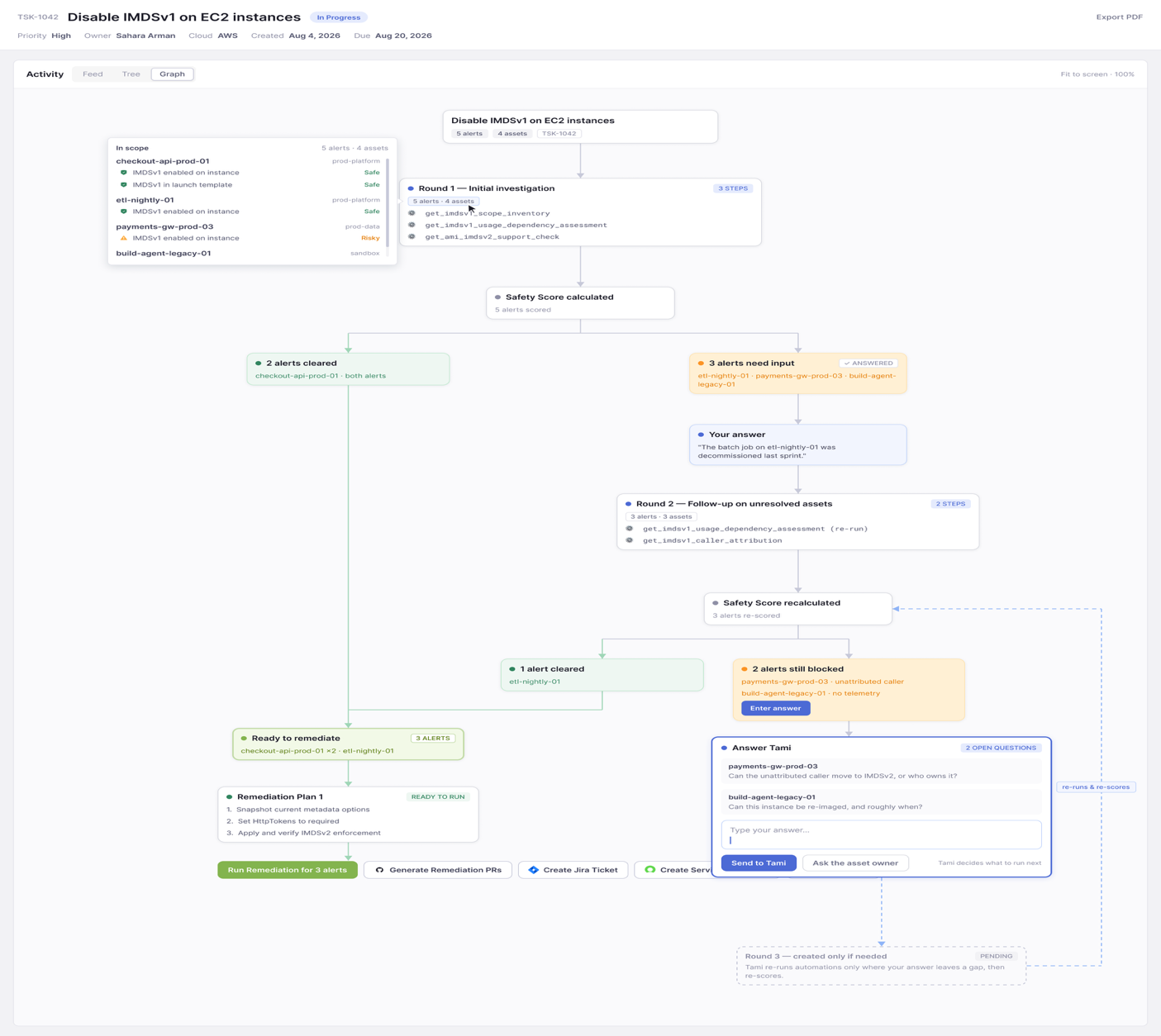
Tamnoon, an AI-powered cloud security remediation company, has published details of Tami, an agentic remediation orchestrator built on Amazon Bedrock. The system ingests findings from cloud-native application protection platforms and posture scanners, decides whether each finding is safe to fix automatically, and then generates and executes the fix under human governance. According to AWS and Tamnoon, the approach produced an over 90 percent reduction in critical cloud exposure within 90 days, with zero production issues.
The problem Tami targets is familiar to anyone running cloud security at scale. CNAPPs, cloud provider native tools and posture scanners generate thousands of findings, and most sit untouched not because they are technically hard to fix but because each one requires a human to gather context, find the owning team, confirm the change is safe, and then make it. Tamnoon describes this as risk compounding in the gap between detected and fixed, with senior engineers spending hours per finding on repetitive investigation work. Fear of breaking production is the force that stops teams from automating remediation, and without clustering or confidence scoring, teams work through alerts linearly rather than resolving the root causes behind many alerts at once.
Tamnoon's pipeline normalizes findings from tools including Wiz, CrowdStrike, Palo Alto Cortex, Upwind, SentinelOne, Orca, Cyera, AWS Security Hub and Amazon GuardDuty into a unified schema, enriches them with asset and exposure context, and prioritizes them. Four specialized agents then handle separate phases, each running in an event-driven serverless architecture on AWS so stages scale independently and fail safely.
The investigation agent determines context and produces read-only investigation steps, filtered through an LLM-as-a-judge validation layer. The safety-scoring agent builds an evidence chain per asset and classifies each finding as SAFE, RISKY or AWAITING DATA, with a deliberately conservative bias that downgrades when in doubt. The remediation agent only activates for findings the safety agent has cleared, then reasons through ordering, dependencies and conditions to produce a plan in which every step follows a backup, remediate and verify structure with rollback guidance. Finally, a code-generation agent turns plan steps into executable remediation, but only after an input guardrail screens for relevance and prompt injection, and every artifact must pass a generate-and-review loop in which a separate reviewer agent approves the output.
On the customer-facing side, Tami assigns a Remediation Confidence Indicator of SAFE, RISKY or AWAITING DATA per finding. That rating is what tells a team which fixes can run automatically and which need a human first. SAFE actions can auto-execute, while RISKY or AWAITING DATA items pull in Tamnoon's embedded cloud engineers. The result reaches customers through destinations they already use, including Slack, Jira, ServiceNow and GitHub.
The architectural choices are instructive for teams building their own agents. Tamnoon runs entirely inside its own AWS accounts, isolated per environment, with a single entry point on Amazon API Gateway, encryption via AWS Certificate Manager, and sign-in through Amazon Cognito. Behind that, Amazon EKS runs the always-on dashboard services while AWS Lambda handles event-driven collection, analysis and remediation. Amazon EventBridge, Amazon SQS and AWS Step Functions coordinate the work so large batches process in parallel without a single bad record stalling the rest. The AI layer uses Amazon Bedrock, Amazon Bedrock AgentCore for governed agent action, and Amazon Bedrock Guardrails on both requests and generated code.
Tamnoon chose Bedrock partly because its agents do different kinds of work. Some need deep investigative reasoning; others do high-volume cheap validation; others review generated code where quality and cost must be balanced. Through a single API each agent can call the model best suited to its job, and models can be swapped or upgraded without re-plumbing the architecture. Bedrock Cross-Region inference routes requests to the optimal region within a geographic boundary without custom routing code. Inference runs inside Tamnoon's own AWS environment under IAM-scoped permissions, so customer data stays within the trust boundary, and Bedrock does not retain or train on prompts or completions. Every Tami workload invokes Anthropic Claude on Bedrock via the ChatBedrockConverse interface rather than a third-party endpoint, with model versions pinned to dated identifiers such as claude-sonnet-4-5-20250929.
The safety story is where most of the design effort appears to have gone. No remediation is written until an independent safety assessment concludes the change is safe. Investigation steps are validated as strictly read-only, so understanding a problem can never alter it, and only the remediation path may change anything. Each generation step is paired with a reflection step that feeds critique back into regeneration. Agent output is validated against automation results, user feedback and training data from real fixed alerts, and a human is brought in when the model cannot reach an accurate result alone. At execution time the AI never holds cloud credentials; actions are brokered through short-lived, tenant-scoped credentials under customer-controlled trust in an environment isolated from the agents that plan the work.
Guardrails are enforced at the Bedrock layer so no individual function's prompt logic can bypass them. PII and secret-like content is masked before it is persisted or surfaced, prompt injection is filtered, and denied topics plus content filters keep output scoped to security remediation. Interventions are logged alongside AWS CloudTrail. Access is per-service IAM execution roles, with the only Bedrock permission being bedrock:InvokeModel scoped to specific inference-profile and foundation-model ARNs, and no ability to manage, train or export models. Multi-tenant isolation is enforced from the first call using OAuth2 client credentials through Cognito scoped per application, with work processed one SQS message at a time carrying its tenant context. Infrastructure, IAM policies, network placement, model IDs and alarms all live in versioned CloudFormation and SAM templates, and deterministic decoding with temperature set to zero keeps scoring and planning consistent across runs.
Tamnoon says Tami has analyzed more than 14 million cloud alerts across its customer base, a figure tracked in its 2026 State of Cloud Remediation report, and that results for a typical customer show up within 90 days.
A reasonable trade-off to note is that autonomous remediation shifts effort from writing fixes to validating safety claims. Tamnoon's answer is layered conservatism: the SAFE classification gates automation, and anything uncertain escalates to a human. Whether that holds up across unusual customer environments is the kind of question that only operational history answers, and the reported zero-production-issue record is Tamnoon's own.
Why it matters: security and platform teams evaluating agentic remediation now have a concrete reference architecture, including model routing across tasks, read-only versus write separation, credential brokering and Bedrock-level guardrails. The confidence-rating pattern suggests a practical middle ground between manual ticketing and fully unsupervised automation, where only findings explicitly cleared for safety execute without a human. Teams building similar agents can borrow the generate-and-review loop and the pinned model versioning without adopting Tamnoon's product.
Based on reporting from the original publisher. Visit the source for full context and later updates.
Publisher excerpt
Learn how Tamnoon built Tami, an agentic cloud remediation orchestrator on Amazon Bedrock that autonomously investigates and safely remediates cloud security findings from CNAPP and cloud-native sources. The approach drove a 90%+ reduction in critical cloud exposure in 90 days with zero production issues.