NVIDIA Agent Toolkit Expands, Grounding Enterprise Agents in Company Data
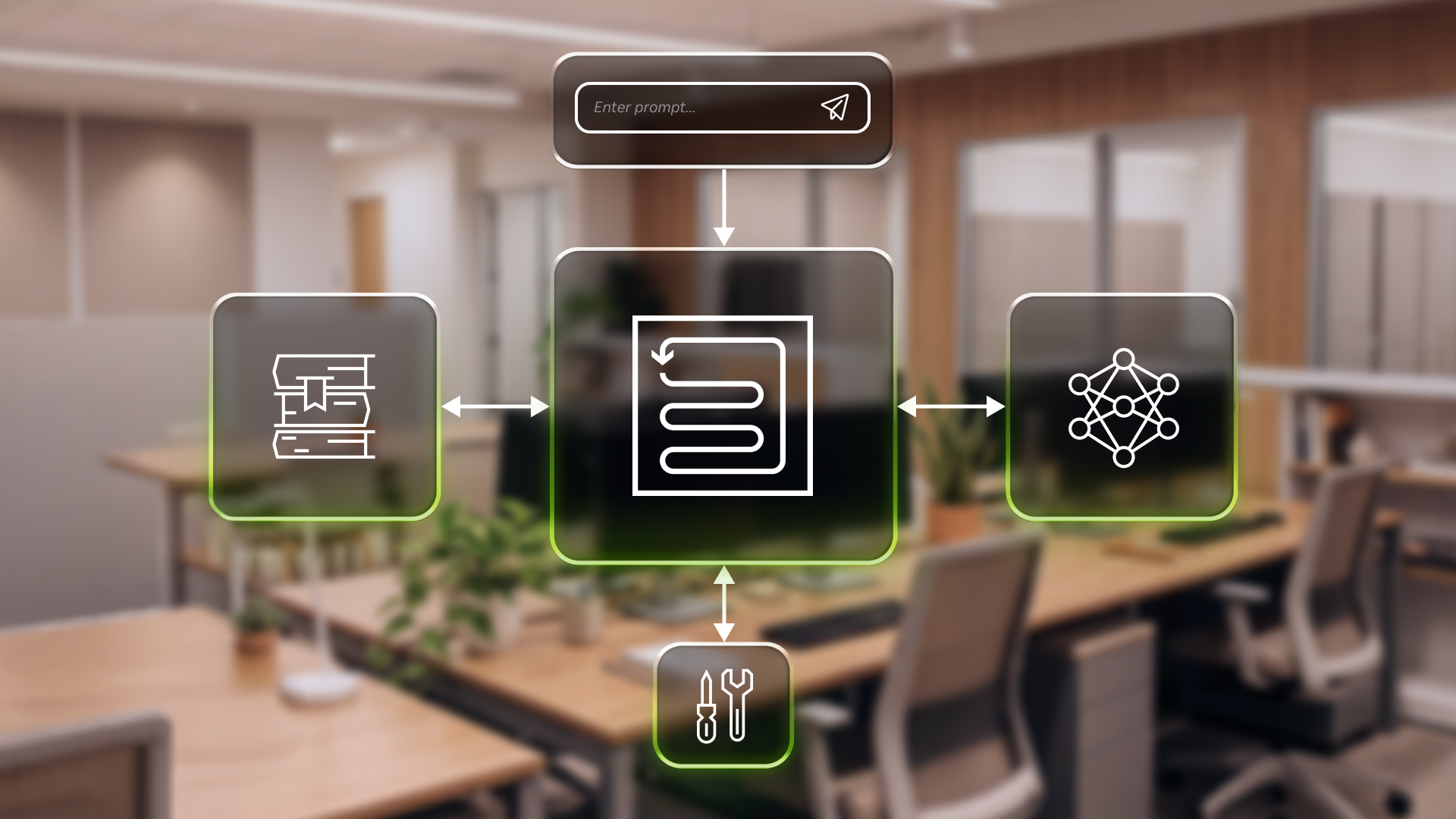
NVIDIA has expanded its open source Agent Toolkit, adding a new Agent Knowledge Foundation alongside a Kumo family of open models, a secure runtime called OpenShell and a fresh NemoClaw blueprint for agent optimization. The company detailed the additions in a European announcements round tied to GTC Berlin 2026.
The toolkit is assembled from several layers. The Knowledge Foundation sits with CUDA-X libraries; Nemotron Retriever and the Kumo models supply retrieval and prediction; OpenShell defines the runtime boundary; NemoClaw provides reference blueprints; and tools such as NeMo Relay and NeMo Compass round out the harness. NVIDIA frames the combination as an open agent stack spanning models, harness, runtime, data and tools, spanning development through deployment.
The Agent Knowledge Foundation is the headline piece. NVIDIA says it lets enterprises convert internal data into company intelligence agents can act on, so agents can locate relevant information, interpret what it means for the business and use it to make predictions or inform decisions. Notably, NVIDIA says companies can adopt it without moving data, rebuilding existing workflows or changing governance controls — a pitch aimed at the common enterprise objection that grounding agents in private data means a migration project and a fresh compliance review. In practice, that suggests the foundation is meant to sit on top of existing data estates rather than replace them, which matters for teams whose data sits behind warehouse, lakehouse or ERP boundaries they cannot easily relocate.
Underneath, the foundation bundles CUDA-X libraries including cuDF for dataframes, cuGraph for graph analytics, cuML for machine learning, cuOpt for optimization and cuVS for vector search. It adds a new Auto-Ontology library that translates raw company data into familiar business concepts such as customers, products and orders and maps the relationships between them. Ontologies are the glue that makes enterprise agents useful: rather than guessing at table schemas, an agent can reason over named entities and their links, which is the same idea Palantir has long sold through its Ontology layer. Automating that mapping is the hard part, and Auto-Ontology is NVIDIA's answer to it.
The model side includes Nemotron Retriever for search and the Kumo Structured line: Kumo Tabular, Kumo Relational, Kumo Time Series and Kumo Forecast. These are aimed at finding relevant company information and producing predictions — tabular and relational data, time-series analysis and forecasting. Databricks, for instance, pairs NVIDIA Kumo Anomaly with its Genie Ontology for context-aware agents, and Snowflake is enabling the Kumo Engine and Kumo Relational open models inside Snowflake Notebook environments.
OpenShell handles the security boundary, giving enterprises control over what agents may reach and do, while NemoClaw blueprints offer reference designs for secure, specialized agents. The newest NemoClaw blueprint focuses on agent optimization, a step-by-step starting point for improving agent performance over time — essentially a template for the evaluation-and-improvement loop that separates demos from production systems.
Early adopters are already named. NVIDIA's own supply chain organization is using the Knowledge Foundation through Palantir Foundry, Ontology and AIP to deploy specialized agents, derive intelligence from proprietary data and predict outcomes. Beyond Databricks and Snowflake, NVIDIA lists AWS, ClickHouse, Cloudera, Cohesity, Dassault Systèmes, Dell, Elastic, Exa, IBM, NetApp, Oracle, Perplexity, Starburst and VAST Data as building on the foundation.
Nemotron Retriever has published performance claims from partners. Amazon OpenSearch Service reported improved relevance with fewer search steps and virtually no added latency using the embedding model. SAP said its fine-tuned reranker ran nearly three times faster. ServiceNow reported better reranking quality with latency cut by nearly a quarter. Zoom is applying the retriever models to document understanding, search relevance and context retrieval in Zoom AI Services. These are vendor-reported figures without published benchmark methodology, so treat them as directional.
A likely trade-off is lock-in versus openness: the stack is described as open source and built on open models, which lowers the barrier to experimenting, but the deepest integration paths run through NVIDIA's CUDA-X libraries and hardware. Teams on other accelerators may find parts of the foundation less useful. The emphasis on not moving data also implies federation across existing stores, which typically trades some query latency and freshness for governance simplicity.
Why it matters: enterprises building agents have struggled to connect them to private data without sprawling migration and compliance work, and this release packages retrieval models, an ontology layer, a runtime and blueprints as one open stack. Developers evaluating agent platforms now have a concrete alternative to stitching together separate vector databases, embedding models and orchestration frameworks, though the partner performance numbers need independent verification. Product teams should watch how tightly the foundation couples to NVIDIA hardware, since that will determine whether it becomes a neutral data layer or an accelerator-specific one.
Based on reporting from the original publisher. Visit the source for full context and later updates.
Publisher excerpt
Agents are only as useful as what they know, and only as trustworthy as the boundaries they run within. Leading enterprises are using the open source NVIDIA Agent Toolkit — now expanded with new tools — to customize and control agents, use company data to inform their answers and actions, monitor what they do and […]