Announcing new ways to customize models with SageMaker AI, without managing GPUs
AWS announced the general availability of training sessions for Amazon SageMaker AI serverless model customization, an expansion of the serverless customization offering it had already launched. The new capability gives customers control over post-training logic without managing the underlying GPU infrastructure. It is available today.
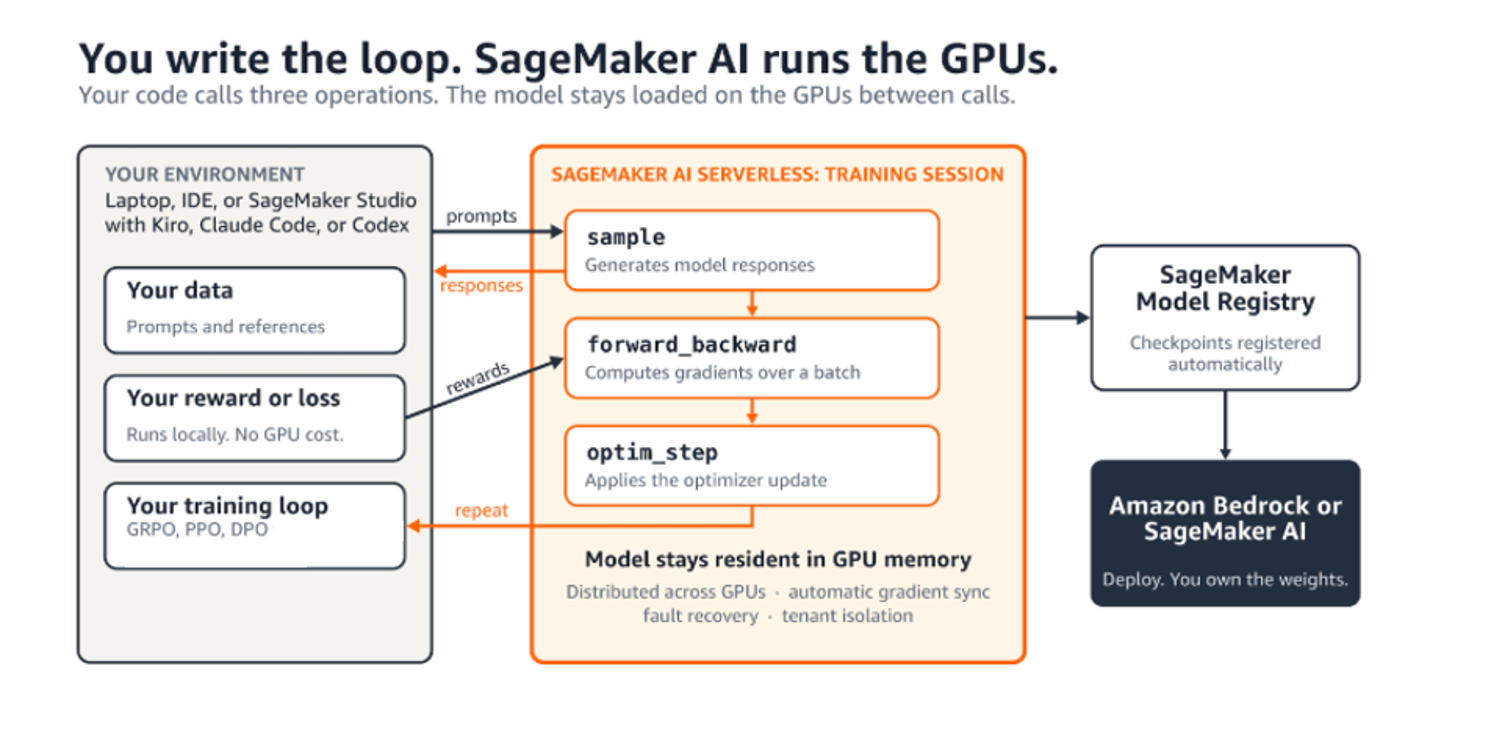
With training sessions, developers write and coordinate the training loop themselves, including custom loss functions or reward signals, while SageMaker AI takes over GPU allocation, distributed execution, fault recovery and checkpoint storage. Users do not pick instance types, manage clusters or write distributed training configuration.
The technique menu is deliberately broad: supervised fine-tuning (SFT), direct preference optimization (DPO), reinforcement learning with verifiable rewards (RLVR), reinforcement learning from AI feedback (RLAIF), and multi-turn RL. Teams can also decide how much of the model to update, using Low-Rank Adaptation (LoRA) or full fine-tuning, and can chain techniques together through a feature AWS calls continuous customization.
AWS frames the product around multi-turn reinforcement learning, where an agent that books travel, triages support tickets or performs multi-step research must interact several rounds before its outcome can be judged. The operational pain is that such a loop typically trains on one set of infrastructure, runs inference on another to generate responses, scores them elsewhere, then feeds results back — each stage with different compute needs, spread across separate tools and clusters. SageMaker AI already offered multi-turn RL as a managed, serverless technique; AWS says customers asked for the ability to define their own loss functions, shape reward signals, or arrange RL stages in a single loop, which is the gap training sessions fill.
The mechanics split responsibilities. Customer code runs the training loop and reward function in its own environment and connects the agent to tools or simulators. The training session does the GPU-heavy work through two components: a sampler that generates responses and a trainer that calculates gradients and updates weights. The exact sequence follows whatever algorithm the developer writes.
AWS illustrates this with Group Relative Policy Optimization (GRPO), which generates several responses to the same prompt, scores them, and uses their relative performance to update the model. One pass has four steps: the loop asks the sampler to generate several responses per prompt with the current model; the reward function scores each response in the customer environment using a verifier, reward model or test harness; the loop sends scores back to the trainer, where forward_backward() computes gradients and optim_step() applies the weight update; finally the loop asks the session to refresh the sampler with updated weights and starts the next batch. The cycle repeats until training completes. Having a sampler and trainer as separate surfaces that can be refreshed from one another is the practical answer to the train-here, infer-there split described above.
Pricing follows processed tokens: customers pay for the tokens SageMaker AI processes, the meter stops while the reward function scores a batch in the customer environment, and there is no capacity to reserve. That structure means a scoring step that calls out to external systems or runs a lengthy verifier does not accrue inference charges during the wait, which is a notable difference from reserving instances by the hour.
Control and governance are addressed explicitly. Each session runs under an AWS Identity and Access Management (IAM) execution role the customer creates, and customers can add their own AWS Key Management Service key and virtual private cloud configuration. Data stays in the customer's own Amazon S3 buckets in a chosen AWS Region, and checkpoints land there too. AWS states it does not use customer data or customized weights to train another model. Before deployment, teams can evaluate a model for accuracy, bias and safety; after deployment, guardrails and Amazon CloudWatch monitoring apply.
The launch ships with support for four open-weight models: gpt-oss-20b, gemma-4-31B-it, Qwen3.6-27B and Qwen3.8-27B. Two entry paths exist. Developers working in an IDE install the SageMaker Python SDK on Linux or macOS with Python 3.10 to 3.12, clone the cookbook and start. In SageMaker Studio, a ready-to-use AI development environment launches in under 20 seconds; users open a notebook, connect a coding agent, and download the agent skills and cookbook. The cookbook includes examples, use cases and model customization agent skills — a describe-your-use-case workflow in which an agent handles data prep, technique choice, training, evaluation and deployment, working inside SageMaker Studio, Kiro, Claude Code, Codex or GitHub Copilot.
Two customers are cited. Rob Gontarek, Senior Vice President of Data Science at ImagineSoftware, describes using the service for a healthcare claim-denial triage model and points to the low-level API surface — control over forward and backward passes, sampling and the optimizer step — as what let its scientists pursue reinforcement learning on an accuracy-critical use case. Nitin Wagh, CEO of Karini AI, describes fine-tuning gpt-oss-20b for agentic multi-turn tool calling against an Amazon Neptune knowledge graph, citing setup without manual tuning or out-of-memory issues and reliable checkpoint-and-resume from an exact step.
In practice, the trade-off is between control and exposure. Writing your own loop gives researchers precise leverage over reward shaping, but the loop, reward function and environment connection are now the customer's code to debug and maintain; AWS only absorbs the infrastructure layer. The fixed model list is also a constraint — teams wanting to customize weights outside those four cannot yet use sessions for them. And token-based billing rewards efficient sampling and cheap scoring, but a reward function that itself calls a large model could shift cost rather than remove it.
Why it matters: Teams doing post-training or agent RL currently stitch together training clusters, inference endpoints and scoring harnesses, and this offering collapses the GPU-facing parts into one metered service while leaving the algorithmic code in the customer's hands. Developers on AWS should expect to spend their effort on reward design and evaluation instead of distributed configuration and checkpoint plumbing. Whether this replaces self-managed RL stacks depends, in my reading, on how well the sampler-trainer refresh cycle performs under real workloads and whether the supported model list grows quickly.
Based on reporting from the original publisher. Visit the source for full context and later updates.
Publisher excerpt
Amazon SageMaker AI serverless model customization now includes training sessions, generally available today. You write and coordinate your own post-training loop (custom loss functions, reward signals, or multi-turn reinforcement learning) while SageMaker AI handles GPU allocation, distributed execution, fault recovery, and checkpoint storage.