Inside-Out AI: Rebuilding Airbnb Behind the Scenes and Across the Guest Experience
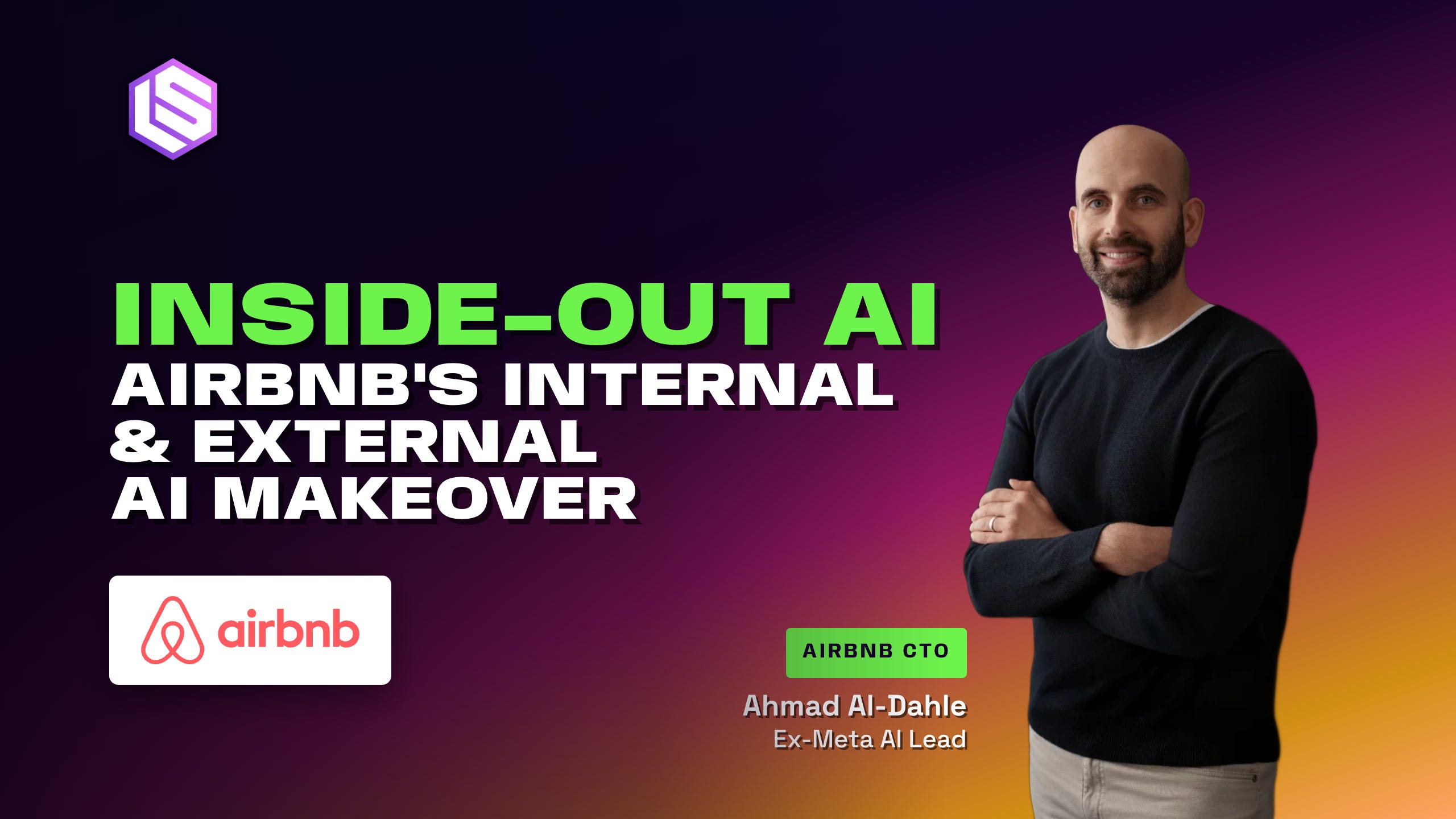
Ahmad Al-Dahle, who led generative AI at Meta and the launch of its open source Llama models from 2023 to 2025, joined Airbnb as CTO in January and is now responsible for making the company what he calls AI-native. He described the approach to Latent Space as inside-out: use AI internally to speed product development, then apply the same capabilities to the guest experience. Airbnb launched in 2008, went public in 2020, and has a market capitalization of roughly $93 billion.
Al-Dahle offered concrete measures of the shift. About 60% of Airbnb's code is now AI-authored, the company has shipped nearly 80% more features and improvements year over year, and pull-request throughput per engineer is up around 1.6x. He said the bigger change is organizational: product, design and engineering teams now move straight to prototypes instead of passing work through requirements documents, design files and implementation handoffs. Code, rather than artifacts such as a PRD, becomes the thing teams reason on.
Customer support was the first user-facing area to get AI, which Al-Dahle called the hardest to deploy because mistakes carry high stakes. Roughly half of support tickets are now resolved purely by AI, he said, a figure consistent with Airbnb's Q2 results, which put it near 45%. The company tests agents against a battery of synthetic data before production, and deliberately routes some cases, such as safety issues, to humans. Two new services drew on an internal context graph called Everest, which uses LLMs, embeddings and AI-based retrieval. Grocery delivery, built first, took eight to nine months; airport pickups took about six weeks, according to Airbnb's Q2 report. Al-Dahle said the graph lets generalists work in specialist parts of the codebase.
Airbnb is a multi-model shop, mixing frontier and open models, doing most post-training and reinforcement learning on open models, and deploying at least 10 customized models in production. It evaluates along a Pareto frontier of cost, performance and latency, running per-use-case evals sampled from production queries and edge cases. Coding gets the strongest frontier model because defects are expensive; latency-sensitive search favors smaller specialized models, which Al-Dahle said can sometimes be post-trained beyond frontier performance. Internally, an agent called AirChat carries organizational context via MCP, and teams are beginning to run asynchronous containerized agents triggered by events, such as monitoring alerts, to triage and start on-call work, with a human reviewing any proposed PR.
Why it matters: Airbnb's numbers show how far AI-assisted engineering and support automation have gone at a large consumer marketplace, and its model-selection strategy, per-use-case evals and asynchronous agent pattern give product and engineering teams a concrete template, including the caution that junior engineers must still be able to explain what they built.
Based on reporting from the original publisher. Visit the source for full context and later updates.
Publisher excerpt
After leading Meta’s Llama models, Ahmad Al-Dahle is now transforming Airbnb with AI — from how its teams develop products to how it serves guests.