llm-gemini 0.38
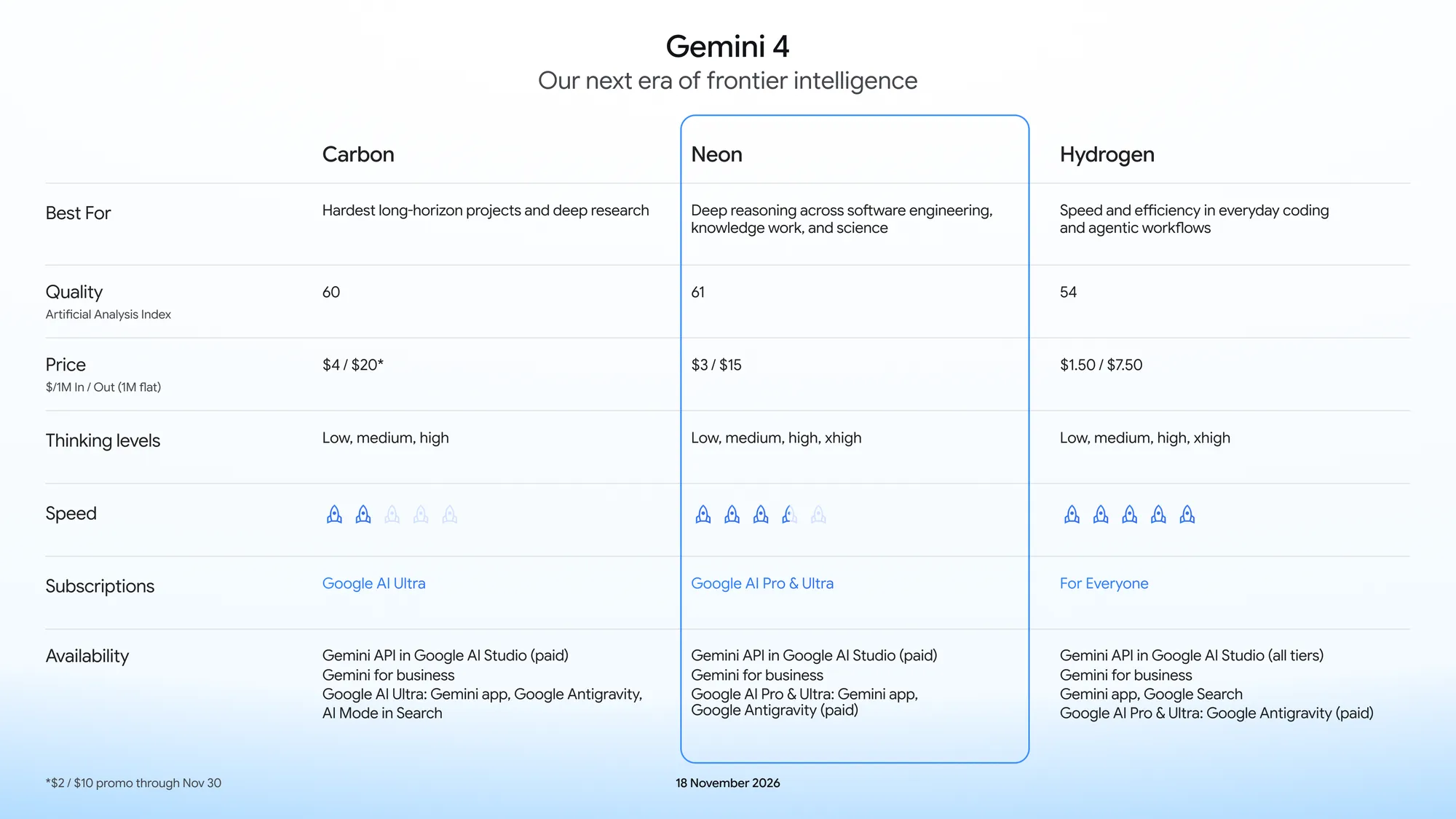
Simon Willison has published version 0.38 of llm-gemini, his plugin that connects Google's Gemini models to his LLM command-line tool, timed to Google's introduction of Gemini 4 Neon. The new model joins the existing Gemini 4 family of Hydrogen, Argon and Carbon, and Willison uses the release post mainly to work through what Neon means for the lineup's pricing and relative capability.
Pricing is the messiest part. In the current Gemini 4 series, Argon and Carbon have carried the same price while Hydrogen was set at three quarters of that figure now, rising to a quarter of it once Carbon and Argon double their rates on 1st December when introductory discounts expire. Willison notes that the Neon announcement treats Argon as though it does not exist, and that the new price chart orders the models as Carbon, Neon and Hydrogen from most to least expensive. The live numbers contradict that ordering, because Carbon is currently at half price.
As things stand, Neon costs $3 per million input tokens and $15 per million output tokens, making it the most expensive of the three right now. Carbon sits at $2 and $10, and Hydrogen at $1.50 and $7.50. On Willison's reading, the published hierarchy will make more sense after 1st December, when Carbon moves to $4 and $20 and Neon's position in the middle becomes consistent with the chart.
For quality, Willison ran his pelican-riding-a-bicycle test across Neon's three reasoning levels: low, medium and high. He dropped Argon from the comparison grid and reports that the Neon outputs look better than Hydrogen and worse than Carbon. That places Neon roughly where its eventual price point implies, though the test is a single informal prompt-and-render exercise rather than a benchmark suite.
He also put Neon through a larger coding exercise at the "extra" effort level inside Google Antigravity, prompting for a Three.js animation in which Yonkers rises as a giant mech, has a dramatic stand-up sequence and stomps across Manhattan, Queens and Brooklyn using OpenStreetMap mapping data. The finished piece is linked from the post rather than described in detail.
For developers, the practical value of this release is that llm-gemini 0.38 is the route to trying Neon from the LLM command-line tool. Anyone budgeting on the published comparison chart should check the effective rates carefully, since discounts and expiring introductory pricing mean the stated ordering does not match what a bill shows today. The trade-off is familiar: Neon is the mid-tier option on output quality but temporarily the most expensive per token, so cost per accepted task may look worse than per-token pricing suggests.
Why it matters: teams using LLM or their own integrations to call Gemini need to model Neon's cost against Carbon and Hydrogen rather than trust the vendor chart, and as inference, the December repricing is likely to shift which tier is the default choice for high-volume workloads. Willison's comparison gives a quick quality signal for that decision, but it is anecdotal and worth validating on your own tasks.
Based on reporting from the original publisher. Visit the source for full context and later updates.
Publisher excerpt
Release: llm-gemini 0.38 Today Google introduced Gemini 4 Neon . I wrote recently about how confusing the pricing for the Gemini 4 series was - Neon has somehow made this even worse. Previously the Gemini 4 lineup was Hydrogen, Argon, and Carbon - where Argon and Carbon were the same price , and Hydrogen was 3/4 of that price now but will be 1/4 of that price when the other two double an 1st December once their initial discount pricing expires. The Neon announcement pretends that Argon doesn't exist. Here's their n