How Stretto built an AI voice agent with Amazon Nova 2 Sonic
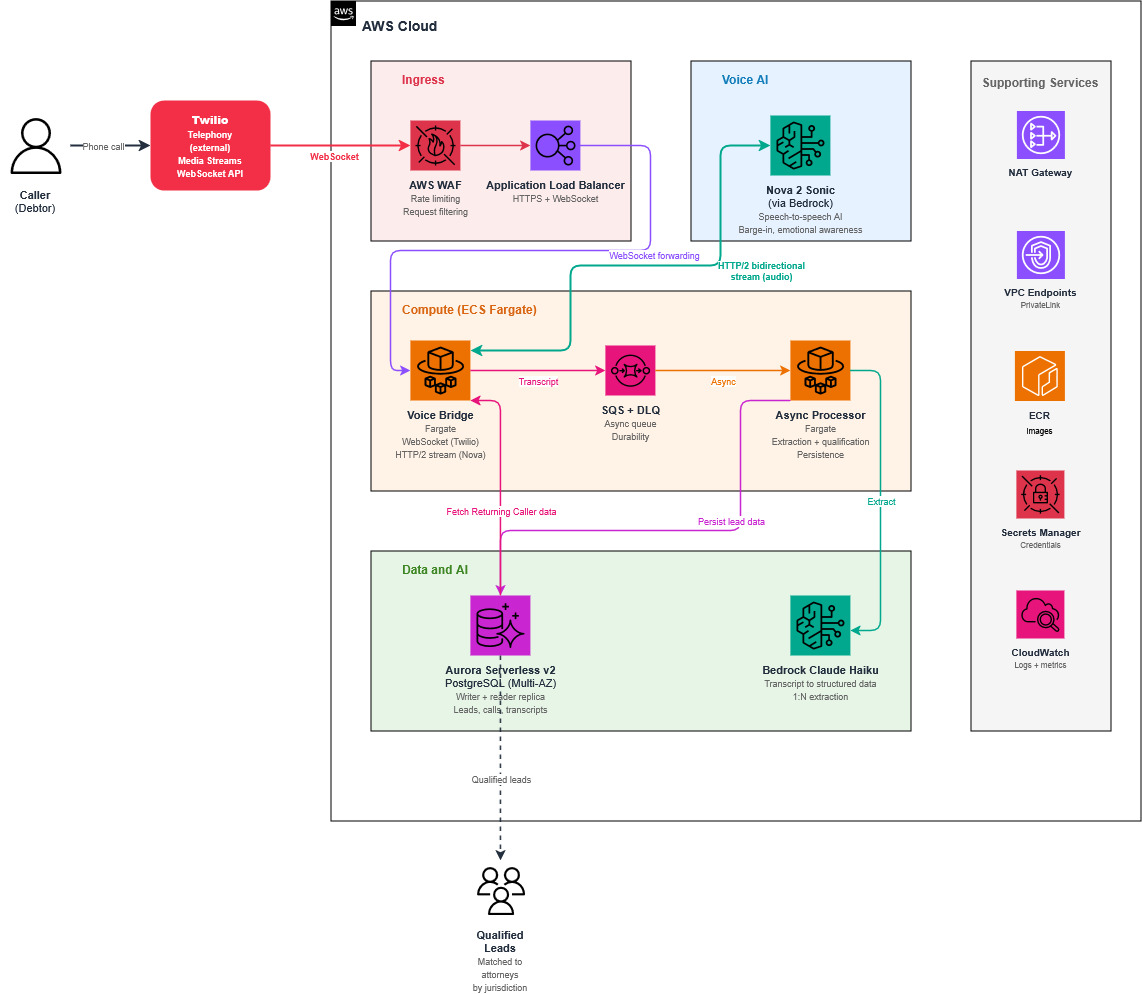
Stretto, a company that runs the Bankruptcy.com consumer site, has moved its bankruptcy intake from a short web form to a phone conversation handled by an AI voice agent named Tara. The build was done with the AWS Generative AI Innovation Center and the AWS Partner CI&T, and the agent runs on Amazon Nova 2 Sonic, a speech-to-speech foundation model available through Amazon Bedrock. Stretto says the system had been in production for roughly three months at the time of writing.
The problem being solved was lead quality. The old form captured only debt amount, attorney status and contact information, which Stretto describes as thin-margin leads. Attorneys reportedly value richer detail: debts, assets, vehicles, real estate, employment history and prior filings. Lengthening the form drove abandonment, and hiring and training human interviewers to run the questionnaire by phone was deemed too expensive. The premise behind the voice agent is that people are more willing to disclose financially sensitive facts in conversation, so a phone interview can collect more without the drop-off a long form causes.
Tara answers the Bankruptcy.com number, introduces herself, collects consent and walks the caller through a structured interview, adapting her tone to the caller's emotional state. After the call, the system applies attorney-defined rules to sort each lead as qualified, disqualified or needs-more-information, and attorneys make the final call. Qualified leads are routed to practitioners by jurisdiction, and callers who don't meet the criteria are pointed to other resources.
On the model side, speech-to-speech means one model takes audio in and produces audio out, rather than chaining speech-to-text, a text language model and text-to-speech. The stated benefit is lower latency and more natural turn-taking, which matters when a caller is stressed and likely to interrupt. The architecture uses Nova 2 Sonic's tool calling for structured capture during the interview, and the Bedrock bidirectional streaming API for real-time audio.
Stretto gives three reasons for the switch from its previous voice stack. First, cost: a reported 95 percent reduction in per-minute voice cost, based on Bedrock on-demand pricing in us-east-1 as of April 2026. Second, latency: the prior solution showed time-to-first-audio above 500 milliseconds in Stretto's testing, which produced awkward pauses. Third, interruption handling: the earlier system handled barge-in poorly and tended to break the conversation flow, while Nova 2 Sonic is designed to absorb interruptions without dropping the session.
The production call path runs from Twilio, which opens a WebSocket into AWS. Traffic passes AWS WAF and an Application Load Balancer to a voice bridge on Amazon ECS with AWS Fargate, which streams audio both ways with Nova 2 Sonic through Bedrock. Bridge tasks run continuously across three Availability Zones. After the call, Amazon SQS with a dead-letter queue hands the transcript to an asynchronous processor, where Anthropic's Claude 3 Haiku on Bedrock extracts typed fields such as names, dollar amounts, addresses and vehicle details. Those fields land in Amazon Aurora Serverless v2, a PostgreSQL-compatible Multi-AZ database holding caller profiles, responses, qualification results and session metadata. Supporting pieces include NAT gateways, VPC endpoints through AWS PrivateLink, Amazon ECR, Secrets Manager and CloudWatch. Access to both models is governed by IAM, and the team notes that Bedrock does not use prompts or outputs to train models.
Stretto chose Twilio because the intake is fully automated with no human agents on the line, and because it wanted a direct Nova 2 Sonic integration while keeping its existing AWS backend. Twilio Media Streams supplies the caller's raw audio over a WebSocket. For contact center workloads that route calls among human agents, Amazon Connect also supports Nova 2 Sonic. Both Nova 2 Sonic and Bedrock are not available in every AWS Region.
The build was phased. Before writing integration code, the team spent a week on voice quality across calm, stressed, hesitant and frustrated caller scenarios, covering time-to-first-audio against the 500 ms baseline, barge-in handling and whether the agent adjusts pace and tone when a caller sounds distressed. That produced a comparison report used as a go/no-go gate. Integration then took about three weeks. The first production release covered the existing 13-field form to establish a baseline; the questionnaire then expanded over four weeks to more than 18 intake categories with conditional branching, where questions depend on earlier answers.
The data model grew accordingly: one caller record can hold four vehicles with year, make, model, financing status and monthly payment each, two properties, dozens of debt line items, multiple employment and income sources, and prior filings, which pushed Aurora into a full relational schema with one-to-many relationships.
One engineering wrinkle is worth flagging for anyone copying the design. The full attorney-designed interview can run 15 to 20 minutes, longer than the maximum duration of a single Nova 2 Sonic streaming session. The team treated that limit as a design parameter and implemented a session continuation pattern: the bridge tracks how long each bidirectional stream has been open, and shortly before the cap it opens a new stream with the same system prompt and tool configuration and passes the conversation so far as text history. When Tara finishes her current response, the caller's audio is switched to the new stream and the old one is closed. In practice this is the kind of constraint that shapes voice agent architecture more than model choice does, and it places the burden on the bridge to carry state cleanly.
Production tuning followed the data. Stretto tracked call volume, average duration, intake completion rate, profile completeness, conversion rate and drop-off points, then reordered questions to cut early drop-off, pulled high-value fields earlier through conditional branching, and adjusted qualification thresholds on attorney feedback. The reported figures: completed calls average about 8 minutes, field extraction runs at roughly 96 percent accuracy in Stretto's testing, and early production shows a 20 percent relative increase in conversion rate against the web form, before broad rollout to additional districts. Danya Gordin, principal AI architect at Stretto, credits the GenAI Innovation Center with the conversion gain; Marcelo Wzorek of CI&T describes taking the agent to production in weeks.
Testing was split into four categories guided by the GenAIIC advisory team: happy-path interviews across the full questionnaire, adversarial callers who contradict themselves, change answers, refuse questions or try to game the qualification outcome, compliance checks for consent and disclosure delivery and data handling, and barge-in scenarios including interruptions during disclosures and mid-question, where the agent must recover without making the caller repeat information. Responsible AI is handled partly as a control rather than only a test: consequential sorting stays in explicit attorney-defined rules outside the model, attorneys decide, and consent and disclosures are delivered and logged before intake starts. The advisory team also covered prompt engineering for voice, including managing state across session boundaries and keeping a consistent agent personality through long interviews.
Why it matters: This is a concrete production case for speech-to-speech voice models in a high-sensitivity, regulated intake flow, and the reported economics — a 95 percent per-minute cost cut, about 96 percent extraction accuracy, an 8-minute average completed call and a 20 percent relative conversion lift — set a benchmark that other teams will be measured against. For developers, the notable lessons are less about the model and more about the plumbing: session-length continuation, a separate extraction pass for structured fields, and rule-based rather than model-based qualification decisions. Teams building similar agents should treat voice-quality validation as a gate before integration, since barge-in and latency problems surface early and cheaply in that phase. Whether the conversion and accuracy figures hold at wider rollout is an open question, and that is inference on my part rather than anything Stretto has stated.
Based on reporting from the original publisher. Visit the source for full context and later updates.
Publisher excerpt
Stretto replaced its web-form lead capture with Tara, an AI voice agent built on Amazon Nova 2 Sonic that conducts bankruptcy intake interviews by phone and qualifies leads. See how Stretto, the AWS Generative AI Innovation Center, and CI&T designed the voice architecture, validated it for sensitive conversations, and moved it to production.